


An on-site dive center is physically located on the resort property and directly manages its own equipment, air fill stations, boats, and certified instructional staff. An outsourced or off-site operation relies on a third-party dive shop based elsewhere to handle transport, gear, and guiding for the resort's guests. The difference changes how your dive day actually runs, and it is worth checking before you book, not after you arrive.
TL;DR
- "On-site" means the resort owns and runs the compressor, boats, gear, and instructors itself; "off-site" means a third party is brought in to cover diving.
- Ask who owns the compressor, who staffs the boat, and where the nearest hyperbaric chamber is before comparing prices.
- Indonesian dive centers must hold valid business licensing under the country's OSS-RBA system, register as a corporate entity, and secure environmental permits. Foreign instructors need valid work permits.
- SSI course progression runs Try Scuba or Basic Diver, then Open Water Diver, then Specialty Diver (2 specialties, 12 logged dives), Advanced Adventurer (5 dives), and Master Diver (4 specialties, Diver Stress and Rescue, 50 logged dives).
- Reconnect runs its SSI dive center directly from Buka Buka Island, with reef sites a short boat ride away rather than a long transfer.
About the author: Reconnect operates an SSI-certified, Blue Oceans certified dive center from its own island property in the Togean Islands, Central Sulawesi, and has guided divers across reef, wall, and pinnacle sites in the Gulf of Tomini since opening. This checklist reflects what we check ourselves when evaluating dive operations against industry norms.
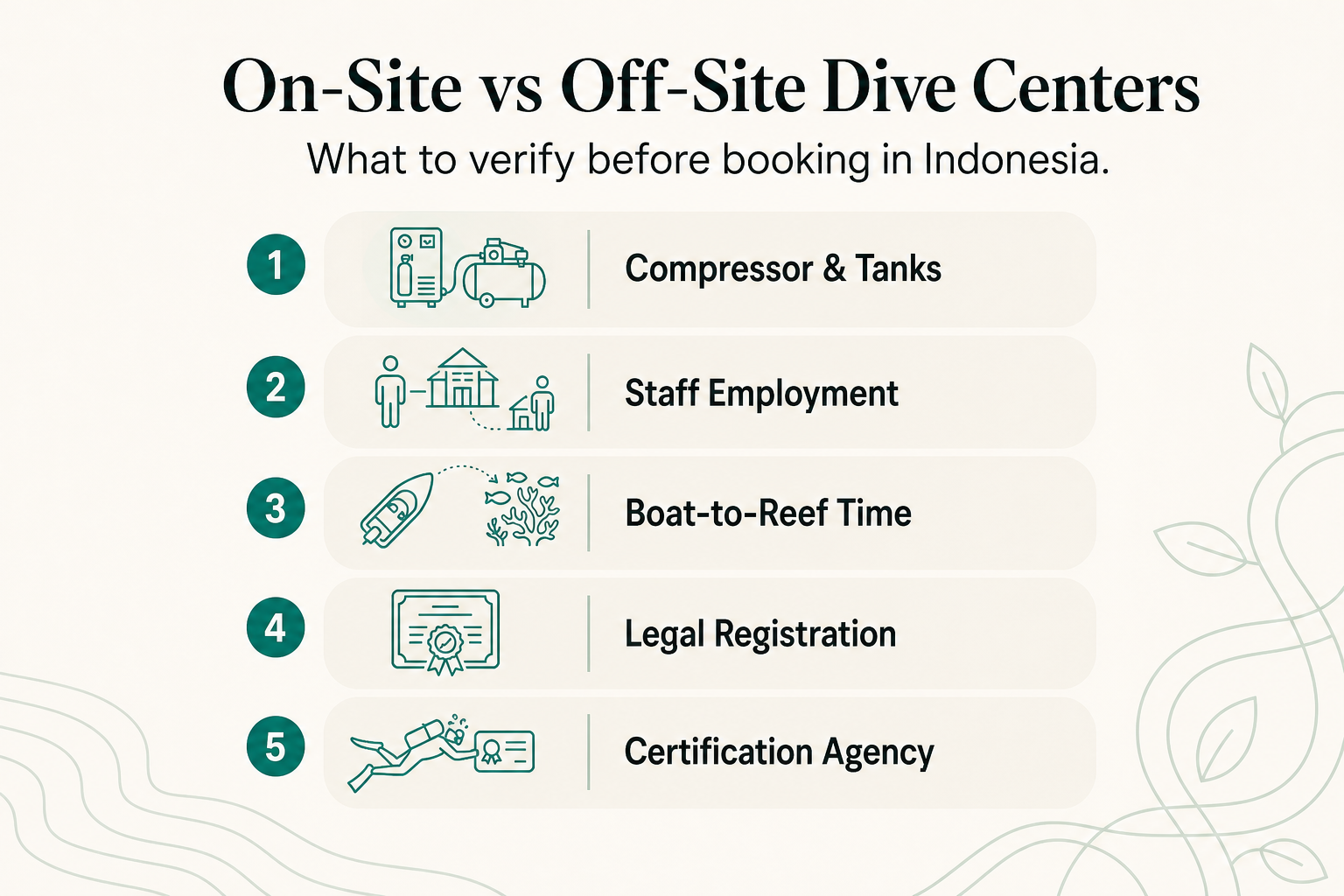
What Does "On-Site Dive Center" Mean in Practice?
The term gets used loosely in marketing copy, so it is worth being precise. An on-site dive center owns its compressor, tanks, boats, and dock, and employs its instructors and divemasters directly as resort staff [bookitletsgo.com]. When something breaks or a boat needs maintenance, the resort controls the fix.
An off-site arrangement means a resort has a partnership with an outside dive shop, which may be based in a different village or even a different island. Your dive day then depends on a second company's schedule, boat availability, and staffing, layered on top of the resort's own.
Neither model is automatically better. A well-run off-site partnership with an experienced local shop can work fine. The point is knowing which one you are booking, because it changes who is accountable when something goes wrong [bookitletsgo.com].
Why Does the Difference Matter for Your Actual Dive Day?
Think of it like a hotel with its own in-house restaurant versus one that calls a food delivery service for every meal. Both can feed you, but one has direct control over timing, quality, and what happens if something runs short.
With an on-site setup, reef access is usually a short boat ride, because the boats and sites are co-located with the property. Dive depths in the Togeans range from 5-meter coral gardens to walls and pinnacles extending well past the 40-meter recreational limit, so the type of site you want to hit also depends on how far the boat has to travel to reach it.
With an off-site model, you are often waiting on a van or boat to bring a third-party team to you, which adds transfer time to every single dive, not just the first one.
Questions worth asking before booking:
- Who owns the compressor and fills the tanks: the resort or a contractor?
- Are the instructors resort employees or subcontracted freelancers?
- How far is the boat ride to the nearest dive sites, in minutes, not kilometers?
- What happens to your dive schedule if the resort's boat needs servicing?
What Should Be on Your Comparison Checklist?
Use this list when comparing any island property in Indonesia, not just in the Togeans.
| Checklist item | Why it matters |
|---|---|
| Equipment ownership | On-site resorts maintain their own gear; off-site arrangements depend on a partner's maintenance schedule |
| Staff employment status | Direct hires are accountable to the resort; subcontractors answer to a separate company |
| Certification agency | SSI, PADI, and others differ in course names and structure; confirm which one the center teaches |
| Boat-to-reef distance | Measured in minutes of boat ride, not just "nearby" |
| Languages spoken by instructors | Matters if you are not booking in English |
| Legal registration | A legitimate operator holds valid business licensing under Indonesia's OSS-RBA system and has completed corporate registration |
| Visibility and site variety | Averages and the range of site types (reef, wall, pinnacle) tell you what diving is actually like |
On the legal point: Indonesian dive centers must register as a corporate entity, obtain valid business licensing appropriate to the risk level of their activities under the OSS-RBA system, and secure environmental permits. Dive staff need recognized professional certifications, and foreign instructors must hold valid work permits. Ask directly if a resort cannot show this, rather than assuming.
How Do Togean Islands Dive Operations Compare?
The Togean Islands, in the Gulf of Tomini off Central Sulawesi, sit inside the Coral Triangle and host several dive-focused properties, each structured differently. Sanctum Una Una operates as a dive resort on Una Una island. The Cliff Malenge runs as a beachfront dive resort on Malenge island. Kadidiri Paradise is a long-established dive resort on Kadidiri island offering diving and bungalow accommodation. Pristine Paradise operates on Una Una island, and Araya Resort is based in the Bomba area.
Reconnect runs its SSI-certified dive center directly from Buka Buka Island, with reef, wall, and pinnacle sites reached by a short boat ride rather than a long transfer. The center holds Blue Oceans certification and teaches in English, French, and Indonesian. Visibility in the Togeans typically averages around 30 meters, which is competitive with destinations like Komodo and Raja Ampat and comes from the calm, sheltered waters of the Gulf of Tomini.
Reconnect is an island eco-resort with an on-site dive center, not a dive-only operation. Diving sits alongside house-reef snorkeling, kayaking, paddleboarding, and village visits to nearby Bajo communities, and the resort runs fully off-grid, with 93% of power coming from solar and the generator serving only as backup.
What Should You Know About SSI Courses Before You Book?
SSI course names get mixed up with other agencies' terminology constantly, which causes confusion when comparing resorts. The progression starts with Try Scuba or Basic Diver for first-timers, then moves to Open Water Diver, which includes academic sessions, confined water training, and four open water dives.
After Open Water, divers can book the Advanced Adventurer course: five dives that build skills across different dive types. Advanced Open Water Diver is not something you book directly. It is a recognition rating awarded automatically once a diver completes 4 specialties and logs 24 dives.
Further up the ladder sits Specialty Diver (2 specialties, 12 logged dives) and Master Diver (4 specialties, Diver Stress and Rescue course, 50 logged dives). Course fees are paid separately from your accommodation rate at any resort, including Reconnect, where all-inclusive full-board pricing covers meals and house-reef snorkeling but not dive certification training.
Frequently Asked Questions
Does "on-site dive center" guarantee better service than an off-site partnership?
No. It guarantees direct accountability for equipment and staffing, but service quality still depends on how well the center is run day to day.
Is Reconnect a dive resort?
No. Reconnect is a private island eco-resort with an on-site SSI dive center. Many guests stay without diving at all, using the house reef, kayaks, and paddleboards instead.
What visibility should I expect diving in the Togean Islands?
Visibility averages around 30 meters, varying by season and site.
Can I book an SSI course as part of an all-inclusive package?
No. Course fees are paid separately from accommodation at any resort. Guided-dive packages, like Reconnect's Dive-cation package (8 dives over 5 days), bundle dives, not courses.
How do I get to a resort like Reconnect in the Togean Islands?
Transfers typically run via Luwuk Airport, with a private car to Ampana and a speedboat crossing to the island.
About Reconnect
Reconnect is a private island eco-resort in Indonesia's Togean Islands, built by founder Thomas Despin on Buka Buka Island in the Coral Triangle. The resort runs 93% on solar power, produces its own desalinated water on-site, and operates a zero single-use plastics policy across 20 rooms. Its SSI dive center, certified by Blue Oceans, offers guided diving in English, French, and Indonesian alongside complimentary house-reef snorkeling, kayaking, and paddleboarding included in every stay.
To see how an on-site dive center actually runs, visit reconnect.id.
References
- 10 Tips For Choosing a Great Dive Centre (bookitletsgo.com)