


UNESCO designated the Togean Tojo Una-Una Biosphere Reserve in 2019, covering 2,187,632 hectares of Central Sulawesi split into a protected core, buffer zones, and transition areas where local communities live and work. For travelers, this status does not mean the Togean Islands Sulawesi region comes wrapped in new rules or restricted access. It means the reefs, mangroves, and forests you encounter sit inside a structure designed to keep conservation and local livelihoods working together, not an area frozen under international law.
TL;DR
- The Togean Tojo Una-Una Biosphere Reserve was designated by UNESCO in 2019, covering 2,187,632 hectares in Central Sulawesi.
- Biosphere status is not a travel permit or restriction system. Actual conservation enforcement comes from the Togean Islands National Park authority, which bans destructive fishing practices.
- The region sits in the Coral Triangle and supports 596 fish species, 33 mangrove species, and 363 plant species, plus endemic animals like the Togean macaque, babirusa, and tarsier.
- A biosphere reserve differs from a national park: the park is the strictly protected core, while the biosphere adds buffer and transition zones where sustainable tourism and local economies are meant to coexist with conservation.
- Practical travel conditions (limited electricity, no ATMs, boat-dependent transport) are unrelated to UNESCO status and come from the islands' remoteness itself.
About the Author: Reconnect has operated an eco-resort and SSI dive center on Buka Buka Island, inside the Togean Islands, since Thomas Despin founded it, working daily with the reef systems and village partnerships that sit inside this biosphere reserve's buffer and transition zones.
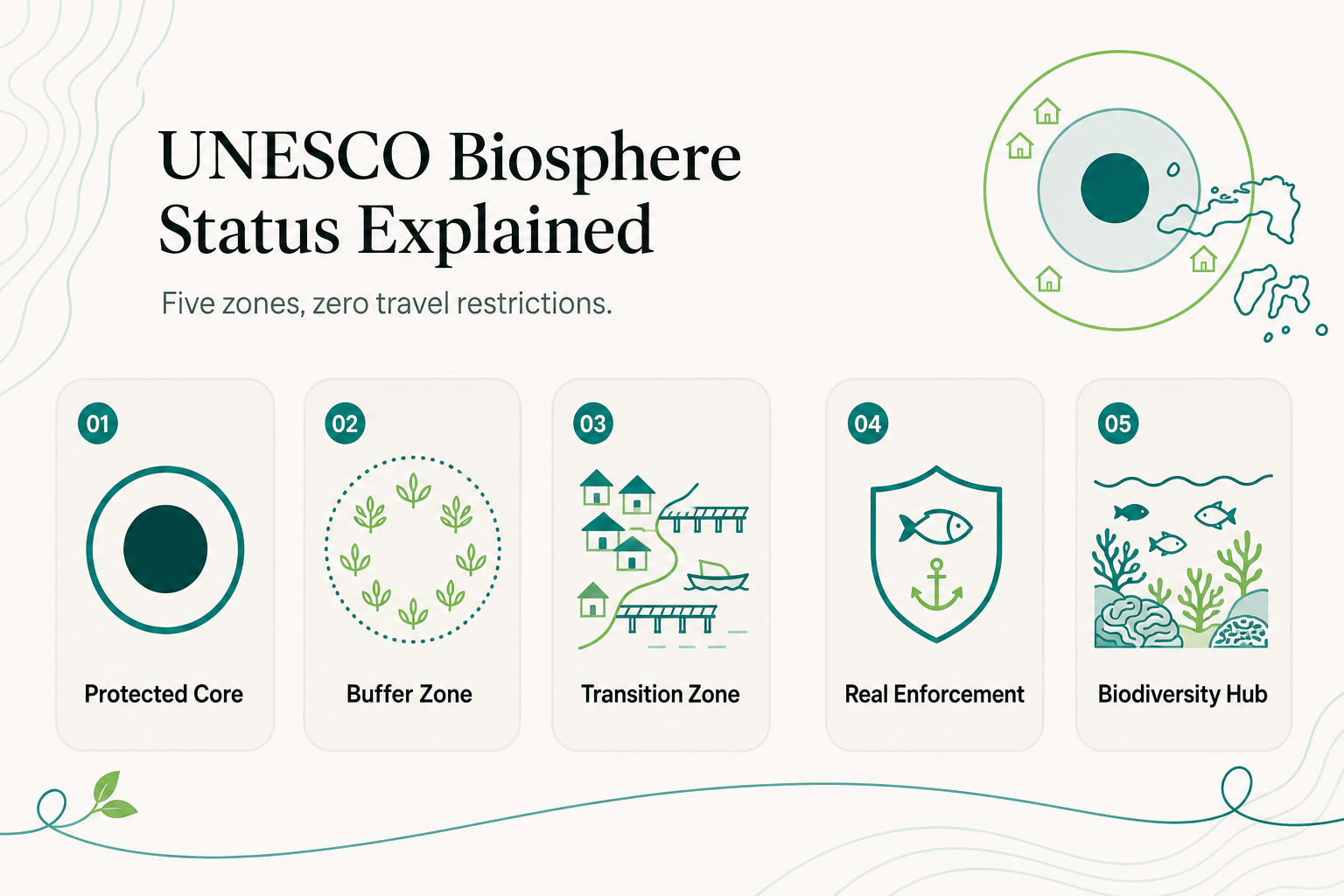
What Is a UNESCO Biosphere Reserve, Exactly?
A biosphere reserve is a zoning framework, not a fence. It requires three things: a legally protected core area, a surrounding buffer zone, and a transition area where people live, fish, farm, and run businesses.
The designation does not create new international law. Enforcement runs through national legislation, which is why the Togean Islands National Park authority, not UNESCO itself, is the body that actually polices fishing practices and habitat protection on the water.
This structure matters because it answers the question travelers actually ask: does this status mean the place is locked down to visitors? It does not. A biosphere reserve is explicitly built to let sustainable tourism and local economic activity continue inside the buffer and transition zones, while the core area carries the strict protection.
When Was the Togean Islands Designated, and What Does the Reserve Actually Cover?
UNESCO designated the Togean Tojo Una-Una Biosphere Reserve in 2019. It spans 2,187,632 hectares across Central Sulawesi.
The core area overlaps directly with the existing Togean Islands National Park, meaning the strictest protections were already in place before the UNESCO label arrived. Around that core sit buffer zones, and beyond those, transition areas containing the villages, fishing grounds, and small settlements that make up daily life in the archipelago.
This layered geography is worth understanding before you book:
| Zone | Function | What a traveler experiences |
|---|---|---|
| Core area | Overlaps Togean Islands National Park; strict legal protection | Reached only via paid day-trip excursions, not casual access |
| Buffer zone | Limits extractive activity, allows regulated low-impact use | Dive sites, house reefs, guided snorkeling areas |
| Transition zone | Sustainable development and local economies | Villages, resorts, markets, boat transport hubs |
Most of what a visitor actually does day to day, diving, snorkeling, staying at a resort, happens in the buffer or transition zones, not the strictly protected core.
Does Biosphere Status Mean New Travel Restrictions?
No. This is the most common misreading of the designation, and it is worth being direct about it. UNESCO does not issue visas, permits, or travel bans tied to biosphere status.
What does affect your trip is the Togean Islands' remoteness itself, which predates and has nothing to do with the 2019 designation:
- No ATMs on most islands, so bring cash from Luwuk or Gorontalo before you travel
- Electricity is limited at most properties, generator-dependent or solar with battery backup
- Transport runs on boats, not roads, so timing and weather affect every leg of a journey
- Mobile signal is patchy outside a handful of resorts and villages
The actual conservation rule that affects visitors comes from the national park authority, not UNESCO: destructive fishing methods, including blast and cyanide fishing, are prohibited within the park's protected waters. That rule existed before 2019 and remains the operative enforcement mechanism today.
How Does Biosphere Status Differ From National Park or Marine Protected Area Status?
A national park is a government-managed conservation zone with legal teeth: it restricts extractive activity and protects specific ecosystems within defined boundaries. The Togean Islands National Park is exactly this, the strict enforcement layer.
A biosphere reserve takes that protected core and builds a wider structure around it. Think of it the way a nature reserve with a working farm on its edge differs from a fenced wildlife sanctuary: the sanctuary (national park) stays untouched, but the surrounding land (buffer and transition zones) is meant to be lived on and worked, deliberately, as part of the conservation model rather than in spite of it.
That is the entire logic of biosphere status: it does not ask people to leave. It asks the people already there, fishing communities, village suppliers, small resorts, to operate in ways that keep the core intact. This is also why sustainable tourism practices, zero single-use plastics, local hiring, reef-safe dive operations, carry real weight in these zones even though UNESCO itself does not inspect or enforce them directly. Compliance is largely voluntary, carried by local operators rather than mandated from above.
What Does the Biodiversity Actually Look Like on the Water?
The Togean Islands sit inside the Coral Triangle, the global center of marine biodiversity. The numbers behind that label are specific: 596 fish species, extensive coral reef systems, and 33 distinct mangrove species across the archipelago.
On land, the picture is just as dense. The terrestrial ecosystem supports 363 plant species, along with animals found nowhere else, including the Togean macaque, the Togean babirusa, and the Togean tarsier.
This is the biodiversity base that reef visibility, dive site variety, and snorkeling quality all draw from. At Reconnect, we see it directly on the reefs around Buka Buka Island, where visibility averages about 30 meters and guided dives move across walls, pinnacles, and reef systems within short boat rides of the resort, all sitting inside the buffer zone this biosphere reserve was built to protect.
What Should This Mean for How You Plan a Trip Here?
The practical takeaway is simple: biosphere status is a reason to respect the reef, not a reason to expect red tape. Pack cash, expect boat-dependent logistics, and choose operators who actually practice what the designation is meant to encourage.
A private island Indonesia stay with a resort that sources locally, hires from nearby villages, and runs on solar rather than diesel generators is not a marketing flourish here. It is the transition-zone model the biosphere reserve was designed around, in practice rather than on paper.
Reconnect sits on Buka Buka Island within this reserve's transition zone, running 93% on solar power with on-site desalinated water and zero single-use plastics, alongside an SSI dive center with direct access to the reefs this designation exists to protect.
Frequently Asked Questions
Does UNESCO Biosphere status mean I need a special permit to visit the Togean Islands?
No. Standard Indonesian visa and entry requirements apply. There is no separate UNESCO permit.
Is the entire Togean archipelago off-limits to development because of the designation?
No. Only the core area, overlapping the national park, carries strict protection. Buffer and transition zones are specifically designed to support local settlements, fishing, and tourism.
How does this designation affect diving and snorkeling access?
It doesn't restrict it. Dive and snorkel sites around islands like Buka Buka sit in buffer zones, where regulated, low-impact use is part of the biosphere model.
Who actually enforces conservation rules in the Togean Islands?
The Togean Islands National Park authority, through national law, not UNESCO directly.
Are there ATMs or reliable electricity in the biosphere reserve area?
Generally no ATMs outside larger hubs, and electricity is limited at most properties. These are remoteness factors, unrelated to the UNESCO designation.
About Reconnect
Reconnect is a private island eco-resort on Buka Buka Island in the Togean Islands, founded by Thomas Despin. The resort runs 93% on solar power, produces its own desalinated water on-site, and operates a zero single-use plastic policy across all 20 rooms. Its on-site SSI dive center gives guests direct reef access within the Togean biosphere's buffer zone, alongside full-board all-inclusive stays from EUR 60 per night.
To plan a stay inside one of Indonesia's most biodiverse marine regions, visit reconnect.id.