


One partner wants to spend the week underwater. The other wants a book, a paddleboard, and a decent flat white. This is not a compatibility problem. It is a logistics problem, and it has a workable answer: build a week where the diver progresses through certification while the non-diver has an equally full, equally satisfying week on the surface, and the two schedules meet at the same table every evening.
That is the plan below, built around how a real course week runs at Reconnect, an eco-resort with an on-site SSI dive center on Buka Buka Island in Indonesia's Togean Islands.
TL;DR
- A standard SSI Open Water course runs 3 to 4 days: theory, confined-water skills, then four open water training dives.
- The non-diving partner has a full parallel schedule available every day: house-reef snorkeling, kayaking, paddleboarding, and one Togean Day Trip into the national park.
- Research on couples and shared leisure time finds that satisfaction with how time is managed, not identical hobbies, predicts relationship success.
- Training dives happen at reef sites around Buka Buka Island by short boat ride, separate from the free-swim house reef.
- The course itself is booked and paid separately from the all-inclusive full-board rate.
Why Does Mismatched Interest in Diving Not Have to Be a Problem?
The instinct is to treat one partner's disinterest in diving as a threat to the trip. It usually isn't. Research on couples and leisure time finds that mutual satisfaction with how time is managed predicts relationship success more strongly than having identical hobbies. Shared activities help, but mismatched adventure interests are not inherently incompatible if the couple shares core values.
The practical translation: don't force parallel identical days. Build two schedules that are each genuinely good, then reconnect at meals. An eco-resort with only a diving focus and nothing else fails the non-diver. An eco-resort with only beach chairs fails the diver. You need both running at once, on the same small property, so the evening debrief happens naturally rather than after a long transfer back from separate bases.
What Does the Diving Partner's Week Actually Look Like?
An SSI Open Water certification is the standard entry course and the one most first-time divers book. It typically takes 3 to 4 days and requires no prior diving experience, just basic swimming ability and a minimum age of 10. The certification qualifies divers to a maximum depth of 18 meters (60 feet).
Day-by-day structure:
| Day | Activity | Notes |
|---|---|---|
| 1 | Academic theory modules, confined water skills | Pool-style skill practice, no depth yet |
| 2 | Confined water skills continue, first open water dives | Training dives happen at reef sites around Buka Buka Island, reached by a short boat ride |
| 3 | Remaining open water dives (4 total required) | Depths build progressively toward 18m |
| 4 | Paperwork, buffer day | Weather buffer if needed |
Course training dives are separate from the complimentary house-reef snorkeling. The house reef is for free-swim access; the checkout dives happen at nearby sites reached by boat, not off the beach. Instruction at Reconnect is offered in English, French, and Indonesian, and courses run in small groups rather than large classes.
For a diver who wants to keep progressing beyond Open Water, the next bookable step is Advanced Adventurer, a five-dive course. Advanced Open Water Diver, by contrast, is not something you book at all. It is a recognition rating SSI awards automatically once a diver logs four specialties and 24 dives.
One clarification that avoids a booking mistake: the dive course itself is priced and paid separately from the all-inclusive full-board rate. The full-board rate covers meals, house-reef snorkeling, kayaking, and paddleboarding. It does not include certification training, which is booked on top.
What Does the Non-Diving Partner's Week Look Like?
The non-diving partner's days need real content, not filler. This is what determines whether the week works for a mixed-interest couple.
Included in every stay, no separate booking:
- House-reef snorkeling, with masks, fins, and snorkels provided
- Kayaking
- Stand-up paddleboarding
- Access to Starlink connectivity if a work call or a video chat with family is part of the day
Bookable as add-ons, same week:
- A guided snorkeling boat trip to additional reef sites around Buka Buka Island, for the days the diver is in deeper water than a snorkeler would want to follow
- The Togean Day Trip, a private boat excursion into Togean Islands National Park
- A village visit to a nearby Bajau (sea nomad) community, for a half-day that has nothing to do with being underwater at all
Sulawesi's reefs are a genuine draw independent of certification status. The Togean Islands sit within the Coral Triangle and are adjacent to Togean Islands National Park. Average visibility here runs 30 meters, clear enough that a snorkeler on the house reef sees most of what a diver fifteen meters below is looking at, just from a different angle. This is one of the more overlooked facts about best snorkeling in Indonesia: you don't need a tank to see the reef structure, the color, and the fish density that make this coastline notable.
How Do the Two Schedules Actually Sync Up?
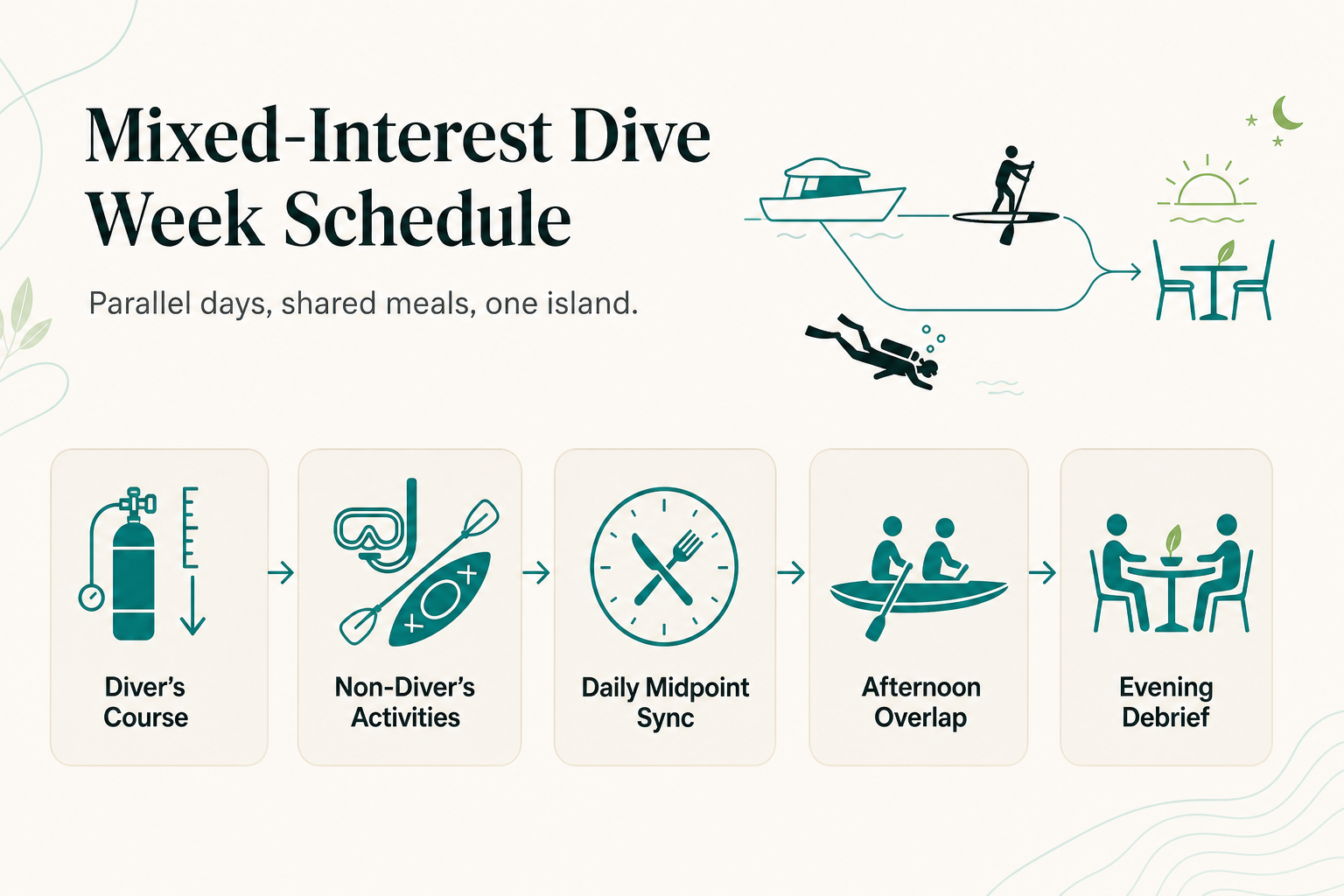
Step 1: Morning split. Diver goes out with the instructor for the day's confined skills or open water dives. Non-diver takes the house reef, a paddleboard session, or sleeps in.
Step 2: Midday check-in. Lunch is full-board and shared, the one guaranteed overlap point every single day regardless of what each person did that morning.
Step 3: Afternoon overlap window. Courses typically finish training activity by mid-afternoon. This is when a joint kayak trip or a walk to the village works, before the light goes.
Step 4: Buffer day placement. Build the Togean Day Trip or village visit into the course's built-in buffer day (day 3 or 4 of the Open Water schedule), so the diver isn't missing a certification dive to join it and the non-diver isn't sitting out a day alone.
Step 5: Evening debrief. Dinner is the fixed point. This is where the diver describes the pinnacle they saw and the non-diver describes the Bajau stilt village they visited that afternoon. Neither day has to have matched to make this conversation work.
Is a Small, Single-Property Eco-Resort Better Suited to This Than a Larger One?
Yes, structurally. An eco-resort with 20 rooms on one small island means the dive center, the kayak rack, the restaurant, and both partners' rooms are within a few minutes' walk of each other. There is no separate "dive base" an hour from the "resort," which is common at larger operations where the two partners would need a car or boat transfer just to reconnect for lunch.
Reconnect runs on 93% solar power with desalinated water produced on site, and is one of the few properties in the Togean Islands offering air conditioning in some room categories (not all), which matters more to the sunbathing partner after a hot midday than to the diver who's been in the warm water typical of this part of Indonesia. The resort is Blue Oceans certified for its dive operations and is adjacent to Togean Islands National Park, reached via the paid Togean Day Trip rather than included automatically in a stay.
Frequently Asked Questions
Can the non-diving partner try a single dive without committing to a course?
Yes, a Discover Scuba Diving course is the standard entry point for someone who wants one supervised dive experience without pursuing certification, distinct from the multi-day Open Water course. [divessi.com]
Does the non-diver need a wetsuit or gear if they're only snorkeling?
No. House-reef snorkeling equipment (masks, fins, snorkels) is provided free of charge for all guests.
What happens if the weather disrupts one of the four required open water dives?
The course structure includes buffer time, which is why a 3 to 4 day estimate rather than a fixed 3-day guarantee is standard for Open Water certification.
Is the course price included in an all-inclusive package?
No. The all-inclusive full-board rate covers meals and non-dive activities; the dive course itself is booked and paid for separately.
How deep does an Open Water diver actually go during training?
Training dives build toward the certification's maximum depth of 18 meters (60 feet), with early dives shallower.
About Reconnect
Reconnect is an eco-resort with an on-site SSI dive center on Buka Buka Island in Indonesia's Togean Islands. Get in touch through reconnect.id to plan a week where one of you dives and one of you doesn't.