


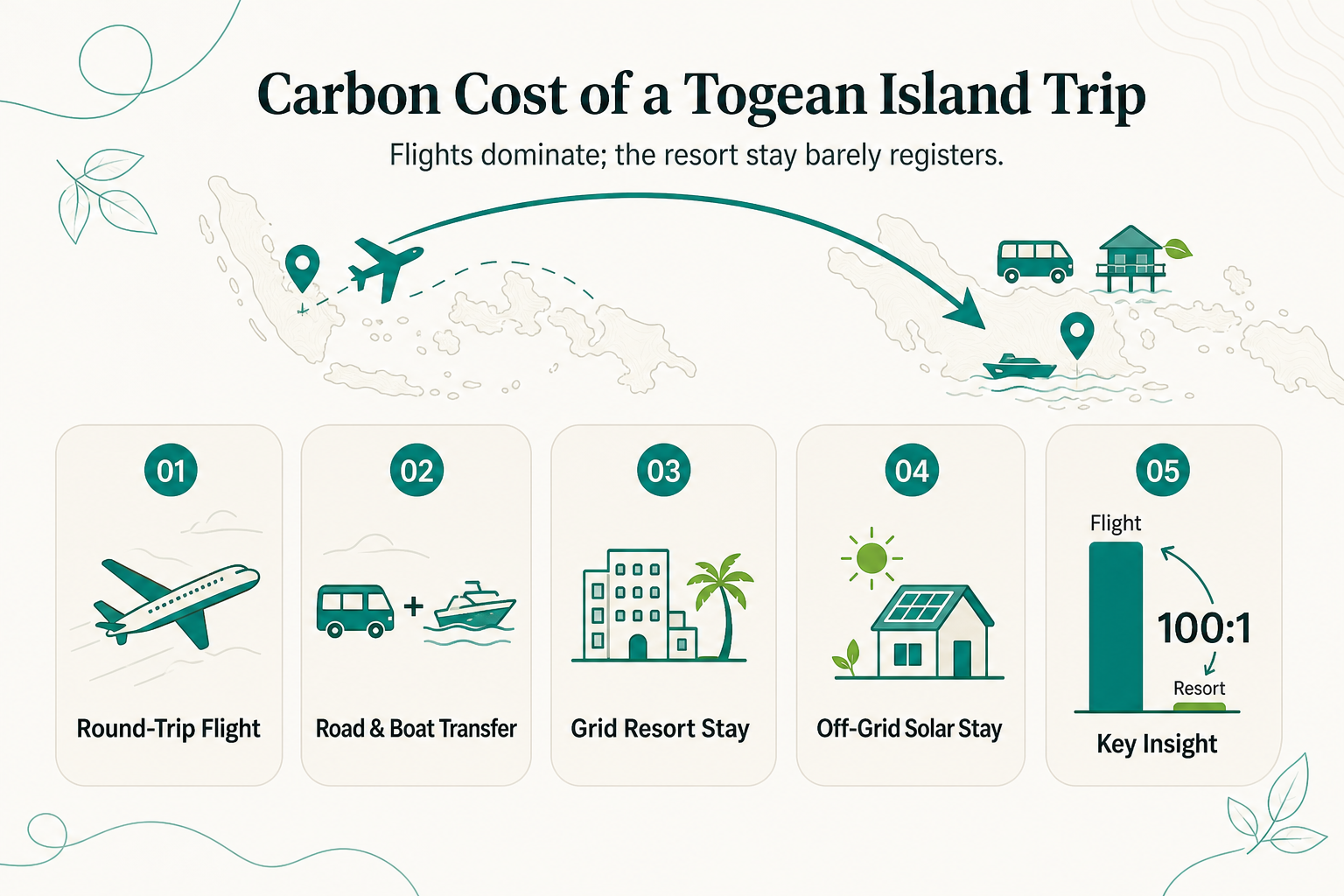
Each leg of reaching the Togean Islands-long-haul flight, domestic connection, 5-hour road transfer, speedboat crossing-carries a measurable carbon cost, and together they make up the overwhelming majority of a Togeans trip's total footprint, not the stay itself. For a European traveler, the round-trip flight alone typically accounts for 1.5 to 2.5 tonnes of CO2, roughly ten to twenty times what a week at an off-grid, solar-powered resort adds on top.
That split matters because it changes where you should actually focus if you care about the impact of the trip. The accommodation choice matters, but it is a smaller lever than most travelers assume.
TL;DR
- Round-trip flights from Europe to Indonesia emit 1.5 to 2.5 tonnes of CO2 per passenger; from Australia, 0.5 to 1 tonne.
- Ferries emit 18 to 19 grams of CO2 per passenger-kilometer for foot passengers, but fast boats and vehicle ferries can exceed 120 grams per passenger-kilometer.
- Indonesia's grid runs on roughly 0.71 to 0.87 kg CO2 per kWh, dominated by coal; solar runs at 0.03 to 0.05 kg CO2 per kWh lifecycle.
- A standard all-inclusive resort stay generates 50 to 120 kg of CO2 per night from energy and amenities; an off-grid solar property cuts the operational share of that close to zero.
- Flights and boat transfers, not the resort stay, make up the largest share of a Togeans trip's total carbon footprint.
About the Author: Reconnect operates a fully off-grid, 93% solar-powered eco-resort on Buka Buka Island in the Togean Islands, and coordinates Luwuk Airport transfers for every guest, which gives us direct, line-item visibility into the real transport and energy costs of reaching this part of Sulawesi.
How Much CO2 Does Flying to the Togean Islands Actually Produce?
A flight's carbon footprint is a function of distance, aircraft type, cabin class, and fuel burn per seat, converted into CO2-equivalent using standardized methodologies. Most reputable flight carbon emissions calculators rely on the ICAO Carbon Emissions Calculator, UK DEFRA/DESNZ conversion factors, or the GHG Protocol, and some, like Atmosfair, add a Radiative Forcing Index because aircraft emissions at altitude have a stronger warming effect than the same CO2 released at ground level.
For a trip to Togean Islands Indonesia, the numbers break down like this:
- Europe to Indonesia round trip: 1.5 to 2.5 tonnes of CO2 per passenger, varying by departure city and whether you fly economy or business.
- Australia to Indonesia round trip: 0.5 to 1 tonne of CO2 per passenger, roughly half the European figure due to shorter distance.
- Domestic connection (Jakarta or Makassar to Luwuk): a smaller add-on, but still non-trivial given multiple takeoffs and landings concentrate fuel burn.
One useful shortcut: flight miles multiplied by roughly 0.18 kg CO2 per mile gives a rough per-passenger estimate before accounting for cabin class or aircraft efficiency [carbonclick.com]. Air travel environmental impact scales with distance in a near-linear way, which is why the single biggest decision affecting your trip's footprint is simply which airport you fly out of, not which resort you book.
Tourism as a whole is responsible for about 8% of global carbon emissions, and transport is consistently the largest contributor within that figure [sustainabletravel.org]. A remote destination like the Togeans concentrates that transport share even further, because there is no short regional flight alternative. You fly a long way, then you travel over land and water to reach it.
What Does the Boat and Road Transfer Add to the Footprint?
The last stretch into the Togeans is where most guides go quiet on numbers, but it is not negligible. Reconnect coordinates the full route: a 5-hour private car transfer from Luwuk Airport to Ampana, followed by a 30-45 minute speedboat crossing to Buka Buka Island.
Boat transport carbon intensity varies more than most travelers expect:
| Transport type | CO2 per passenger-km |
|---|---|
| Foot-passenger ferry (efficient) | 18-19 g |
| Fast ferry or vehicle ferry | 120+ g |
| Private speedboat (short crossing) | varies by engine load and passenger count |
A 30-45 minute speedboat crossing is short in distance, so even at the higher end of boat carbon intensity, it contributes far less than the flights bracketing the trip. The road transfer runs on a combustion-engine vehicle for 5 hours, which is a real emissions line item, but it is still a fraction of a long-haul flight's total.
Swapping speed boating or jet-skiing for kayaking, snorkeling, or sailing meaningfully reduces the on-water portion of a trip's emissions [sailorsforthesea.org], which is one reason Reconnect includes kayaking and paddleboarding at no extra cost rather than motorized add-ons.
Does the Resort Itself Add Much to the Footprint?
A standard all-inclusive resort running on a national grid generates between 50 and 120 kg of CO2 per night. Air conditioning, laundry, kitchen equipment, and continuous grid draw are the main drivers.
Indonesia's grid carbon intensity sits at roughly 0.71 to 0.87 kg CO2 per kWh because of heavy coal reliance. Every kilowatt-hour pulled from the mains in Sulawesi carries a real environmental cost.
Reconnect runs on a different model: 93% solar-powered, with a generator held strictly as backup, never as the primary source. Solar's lifecycle footprint runs at roughly 0.03 to 0.05 kg CO2 per kWh, a fraction of grid coal power.
A diesel generator converts fuel to electricity at roughly 30-40% efficiency and emits CO2 with every liter burned. A solar panel converts sunlight with no combustion step and no fuel input once installed. The emissions difference is structural, not a matter of good intentions.
Resort operations at Reconnect:
- 93% solar-powered, generator as backup only
- On-site desalinated water, sun-powered
- Zero single-use plastics throughout the resort
- All staff hired locally, with supplier partnerships in neighboring villages
None of this erases the flight. But the nightly operational footprint of the stay is close to the lowest end of what is achievable for a resort of this kind, and considerably below the 50-120 kg per night baseline for grid-connected properties.
Does Diving Add to the Trip's Environmental Impact?
Diving tourism across Southeast Asia carries documented environmental risks: physical contact damage to reefs, sediment disturbance from fins and anchors, and localized pollution near high-traffic sites. The carbon footprint tied to diving is dominated by air travel and boat fuel.
Reconnect's on-site SSI dive center sits directly on Buka Buka Island. Reef, wall, and pinnacle sites are reached by short boat rides rather than long transfers. That proximity reduces boat fuel burn per dive compared to operations that run guests to distant sites.
The center holds Blue Oceans certification. House-reef snorkeling, included with every stay, requires no boat at all.
Frequently Asked Questions
Is a trip to the Togean Islands worse for the climate than other Indonesia trips?
Not inherently. The footprint is driven mainly by flight distance and transfer efficiency, which are similar across most remote Indonesian island destinations.
Can I offset the flight portion of my trip?
Reputable offset programs typically price carbon at a rate tied to verified reduction projects; a flight carbon emissions calculator using ICAO or DEFRA methodology will give you the tonnage to offset.
Does flying business class significantly increase the footprint?
Yes. Business and first-class seats occupy more cabin space per passenger, which raises the per-passenger emissions share of the same flight meaningfully above economy class.
Why does the resort stay matter less than the flight in total emissions terms?
Because flight emissions are a fixed, one-time cost of distance traveled, while a well-run off-grid stay's daily operational footprint is already close to zero.
About Reconnect
Reconnect is a Private Island Resort on Buka Buka Island in the Togean Islands, with an on-site SSI dive center and Blue Oceans certification. The resort coordinates full transfers from Luwuk Airport and offers all-inclusive full-board stays from EUR 60 per night. Curious what an off-grid island stay actually looks like in practice? Visit reconnect.id to plan your trip.
References
- Carbon footprint calculation for island vacations (carbonclick.com)
- Carbon Footprint of Tourism - Sustainable Travel International (sustainabletravel.org)
- Vacation Carbon Footprint - Sailors for the Sea (sailorsforthesea.org)