


Under EUR 100 a night, "all-inclusive" in Indonesia rarely means the Caribbean model of unlimited premium alcohol and a beachfront buffet. It typically means three daily meals, local beverages, and non-motorized water sports bundled into the room rate, with wellness extras like spa credits or yoga replacing bottomless cocktails [all-inclusive-guide.com]. The comparison that actually matters isn't price alone. It's what specific inclusions you get per euro, and whether those inclusions match how you actually want to spend your days.
TL;DR
- Caribbean-style all-inclusive (unlimited alcohol, resort-wide buffets) is uncommon in Indonesia at any price point; most properties bundle meals, local drinks and non-motorized activities instead [all-inclusive-guide.com].
- Budget travelers in Bali spend roughly $35/day ($245/week) on a self-managed trip; mid-range runs $80-150/day.
- A 7-night all-inclusive Bali stay costs $1,400-2,100 for a budget traveler and $1,750-3,150 for a mainstream family, before flights.
- EU travelers need an e-VOA (IDR 500,000, about EUR 30), valid 30 days and extendable once by 30 more.
- Reconnect's full-board rate starts at EUR 60/night and includes meals, house-reef snorkeling, kayaking and paddleboarding, with diving and courses priced separately.
About the Author: Reconnect has operated an all-inclusive, full-board eco-resort in the Togean Islands of Central Sulawesi since Thomas Despin founded it, running an on-site SSI dive center and a 20-room off-grid property that has been rated on TripAdvisor, Google and Booking.com by hundreds of guests comparing exactly this kind of value question.
What Does "All-Inclusive" Actually Mean in Indonesia?
The term gets used loosely across Southeast Asia, and Indonesia is no exception. In the US and Caribbean, all-inclusive usually implies unlimited alcohol and a resort you never need to leave. In Indonesia, the standard is different: accommodation, three meals a day, local (not imported) beverages, and non-motorized water sports like kayaking or snorkeling gear [all-inclusive-guide.com].
Spa credits, yoga sessions, and a cultural excursion are common add-ons at the upscale end, replacing the bottomless-cocktail model entirely [all-inclusive-guide.com]. Knowing this before you compare prices prevents a common mistake: assuming a lower nightly rate means fewer inclusions, when it may just mean a different definition of "included."
For an Indonesia-wide search on all-inclusive resorts, this distinction matters more than the number itself.
How Do Indonesia's All-Inclusive Price Tiers Actually Break Down?
Three tiers exist in practice, and the gap between them is wider than most guides suggest. A 7-night Bali stay runs $1,400-2,100 for a budget traveler, $1,750-3,150 for a mainstream family, and $3,850-6,300+ per person at the luxury tier, all before flights, which typically add $800-1,500.
That's a per-night range of roughly $200-300 at budget level once you annualize the week, well above the EUR 100 ceiling this article is built around. The mid-range and luxury tiers push further from that ceiling, not closer.
| Tier | 7-night cost (before flights) | Per-night equivalent |
|---|---|---|
| Budget | $1,400-2,100 | ~$200-300 |
| Mainstream family | $1,750-3,150 | ~$250-450 |
| Luxury | $3,850-6,300+ per person | $550-900+ |
Separately, a day-by-day cost model for Bali puts budget travel at $35/day ($245/week) and mid-range at $80-150/day ($560-1,050/week). Those figures describe piecing together your own accommodation, food, and transport rather than booking a bundled all-inclusive rate, which is why they read lower than the tiered packages above. The two data sets aren't measuring the same thing, and conflating them is where a lot of "cheap Bali all-inclusive" searches go wrong.
Why the gap exists: all-inclusive pricing bundles convenience, meaning someone else has already negotiated transfers, meals, and activities into one number. Self-managed budget travel trades that convenience for lower cost and more of your own logistics work. Under EUR 100 a night, you are almost always choosing the self-managed model, or a property built specifically to hit that bundled price point through a different cost structure than Bali's.
Where Does an Under-EUR-100 All-Inclusive Rate Actually Come From?
A resort hitting EUR 60-100/night with genuine full board isn't discounting a Bali-style package. It's built on a different cost base entirely, and that's worth understanding before you compare it against Bali or Lombok on price alone.
Reconnect, on Buka Buka Island in the Togean Islands of Central Sulawesi, prices its full-board stays from EUR 60/night across its lower-tier rooms (Beachfront Glamping Hut and Pyramid), rising to EUR 175/night for its largest villa (Villa Athena, sleeping up to 4). Every rate includes three meals a day, afternoon tea, unlimited coffee, tea and water, house-reef snorkeling with equipment provided, kayaking and stand-up paddleboarding.
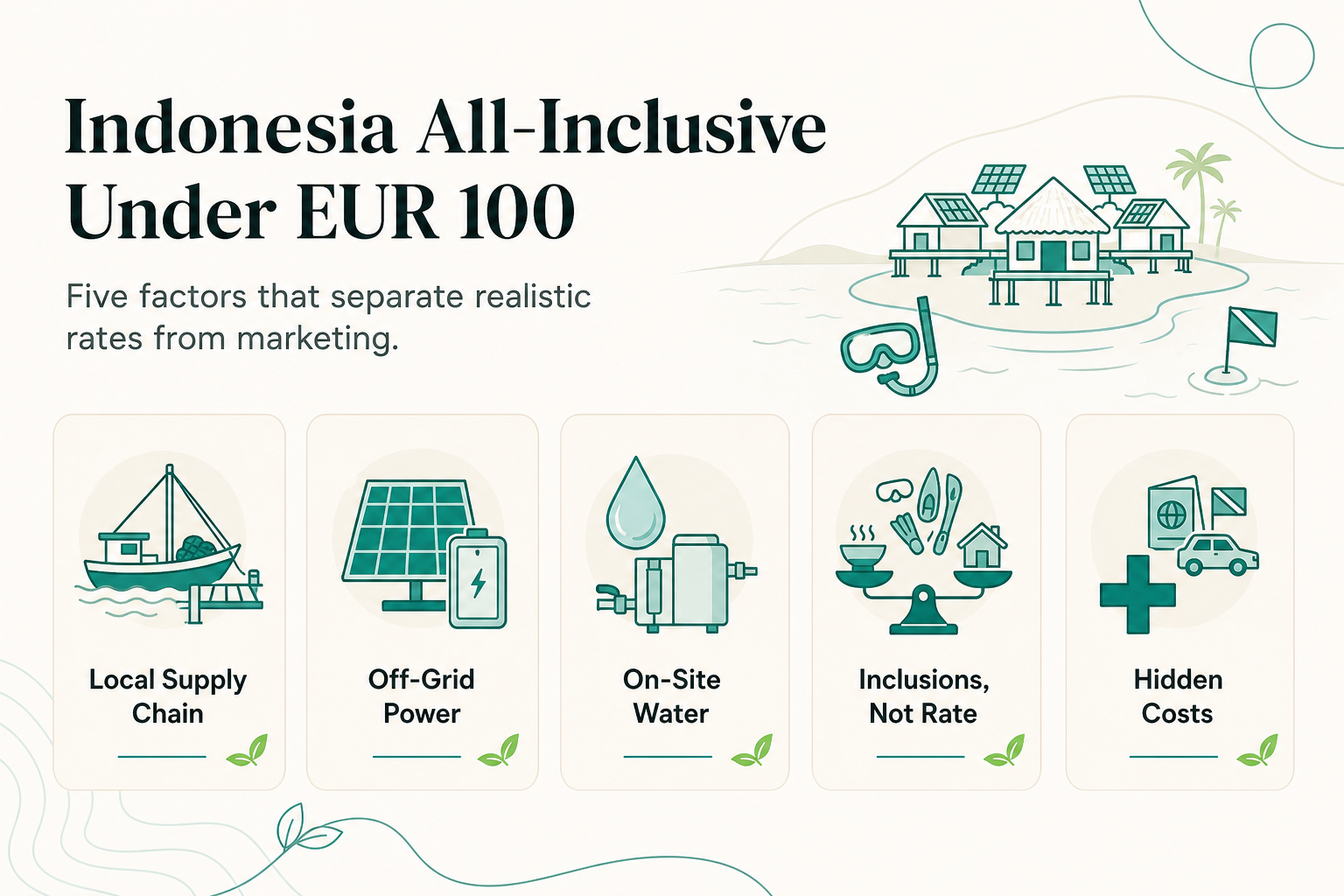
Three structural factors keep that rate low without cutting inclusions:
- Off-grid power: the resort runs 93% on solar with battery backup, with a generator held strictly as backup, removing a recurring diesel-fuel cost that raises operating expenses at grid-dependent island properties.
- On-site water production: desalinated and drinking water are produced on site using solar power, eliminating bottled-water shipping costs.
- Local staffing and supply: staff are hired locally and food supply partnerships run through neighboring villages, keeping labor and logistics costs regional rather than imported.
This is the mechanism, not a marketing claim: lower fixed operating costs on essentials (power, water, staffing) let the all-inclusive rate stay near EUR 60-100 while still covering full board, rather than trimming meals or activities to hit that number.
What Should You Compare Beyond the Nightly Rate?
Price per night is the wrong single metric. What you actually need is inclusions per night against your specific travel style, because two resorts at the same rate can offer very different value.
Step 1: Separate stay inclusions from paid add-ons.
At Reconnect, diving and dive courses are priced and booked separately from the all-inclusive rate; the Dive-cation Package (5 days, 8 dives, full board) is a distinct product, not a stay upgrade. Confirm this split at any property before comparing headline rates, since some list dive credits as "included" when they're bundled at extra cost.
Step 2: Check the visibility and reef-access claim, not just the marketing photo.
Underwater visibility in the Togean Islands typically ranges 20-30 meters, comparable to Raja Ampat or Komodo but with far fewer divers at each site. Reconnect's own reef sites around Buka Buka Island average about 30 meters, reached by short boat rides rather than long transfers, since the dive center operates directly from the resort.
Step 3: Factor in the transfer, since it's rarely mentioned in the nightly rate.
Reconnect coordinates the full route: private car from Luwuk Airport to Ampana (around 5 hours), then private speedboat to the island (30-45 minutes). A resort that omits this from its listed rate isn't cheaper, it's deferring a cost you'll still pay in money or planning time.
Step 4: Confirm your visa cost is factored into the trip total.
EU travelers need an e-VOA for Indonesia in 2026, costing IDR 500,000 (about EUR 30), valid for an initial 30 days and extendable once for another 30. That's a fixed cost on top of any all-inclusive rate, and worth adding to your comparison spreadsheet rather than treating as separate.
Frequently Asked Questions
Is EUR 100/night all-inclusive realistic anywhere in Indonesia?
Yes, at properties built on off-grid power and local supply chains rather than imported infrastructure. Reconnect's full-board rate starts at EUR 60/night on that basis.
Does all-inclusive in Indonesia mean unlimited alcohol?
Rarely. Most properties include local beverages and meals, not unlimited premium alcohol, which is standard in the Caribbean model but uncommon here [all-inclusive-guide.com].
Are dive courses included in an all-inclusive island stay?
Not at Reconnect. The all-inclusive rate covers meals, house-reef snorkeling, kayaking and paddleboarding; SSI dive courses and guided dives are booked and paid for separately.
How does Togean Islands visibility compare to Raja Ampat?
Similar. Both regions offer 20-30 meter visibility and pristine reef conditions, with the Togeans seeing considerably less diver traffic per site.
What visa do EU citizens need for a 2026 Indonesia trip?
An e-VOA, costing IDR 500,000 (about EUR 30), covering a 30-day stay with one 30-day extension available.
About Reconnect
Reconnect is a private island eco-resort in the Togean Islands of Central Sulawesi, built by Thomas Despin as an off-grid, self-sufficient alternative to mass-market beach tourism. The 20-room property runs on 93% solar power, produces its own desalinated water, and holds a zero single-use plastic policy throughout. Its on-site SSI dive center, Blue Oceans certified, gives direct reef access around Buka Buka Island without long boat transfers. Guests rate the resort 4.9 on TripAdvisor, 4.8 on Google, and 9.2 on Booking.com.
For a full-board rate, real transfer logistics, and an honest look at what's included before you book, visit Reconnect.
References
- 12 Cheapest All-Inclusive Resorts for 2026 (Actually Good) | All-Inclusive Guide (all-inclusive-guide.com)
- All-Inclusive Resorts Bali: Real Costs and Top Picks (outboundlynx.com)
- Bali Trip Cost 2026: What I Charge My Guests (Real Receipts) (ohana-agency.com)