
Reconnect ist ein Öko-Resort auf einer Privatinsel und ein SSI-Tauchzentrum auf der Insel Buka Buka, am Rand der Togean-Inseln in Zentralsulawesi, Indonesien. Das Resort hat 20 Zimmer und Villen in 9 Unterkunftskategorien, läuft zu 93% mit Solarstrom und verfügt über eine eigene Meerwasserentsalzung sowie Starlink-WLAN; in jedem Preis ist Vollpension für zwei Personen enthalten. Gründer Thomas Despin kaufte hier 2018 das erste Grundstück, zog 2019 auf die Insel und empfing 2020 die ersten Gäste.
Über uns
Vom Fahrrad in Frankreich zu einer Insel in Sulawesi
Wie Reconnect begann, wer dahinter steckt und wohin es geht.
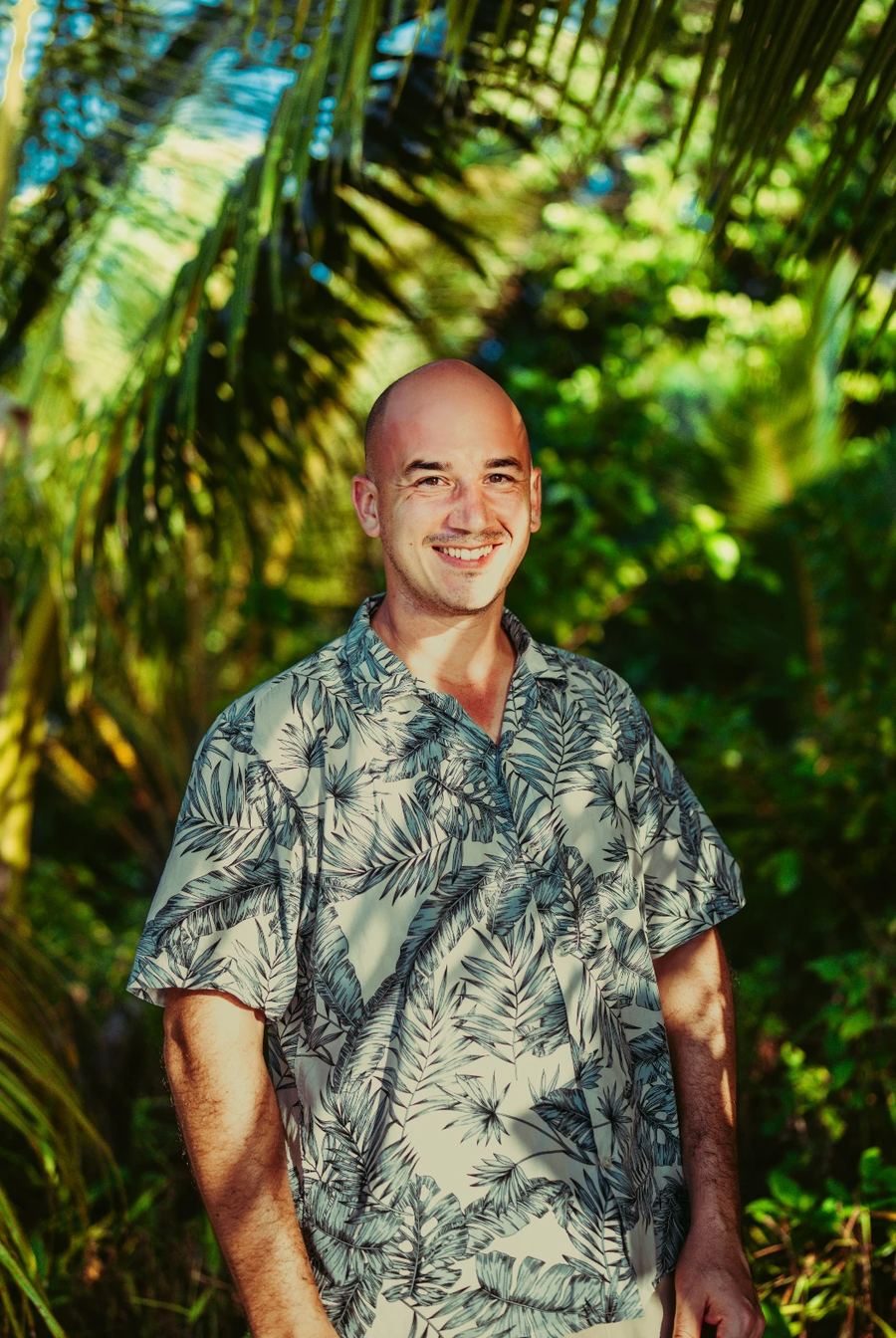
MEET THE FOUNDER
Thomas Despin
I grew up in Bordeaux and never imagined I'd build anything like this. After dropping out of psychology and a few years of restless side projects, I started something called Startup Cycling — riding a bicycle through twenty-odd European countries, then the US and Canada, meeting founders along the way and writing about what they were doing. The plan was to keep going through Asia. The plan didn't survive Bali.
A skimmer cleared out my account at an ATM there in 2016. I couldn't afford the flight home, so I stayed. A Balinese family put me up for a month while I built websites for whoever would pay me. Then I started a dropshipping business with a friend, Nick, in Paris. We lost money for three months, then got lucky with one product and one ad and it worked. By the end of the year I had enough financial runway to take a real risk on something I actually cared about.
Finding Buka Buka
A friend of a friend told me about a plot of land for sale on a small island in the Togean archipelago, in Central Sulawesi. I went out of curiosity. The first time I stepped off the boat — 160 hectares of nothing but coconut trees and a quiet beach — a thought landed almost immediately: I could live here.
That same evening I started writing a post on Facebook about it on the boat ride back. I'd been sharing my projects there for years; this didn't feel different. Within a few days a couple of friends reached out — if you do this, can we be part of it? That's how the first piece of land got bought, in 2018. Not with a business plan, just an honest description of what I was thinking about.
(A few months later my mother sent me a drawing I'd made when I was four or five: a small figure standing on a desert island with a single palm tree. I'd completely forgotten about it.)
Building from first principles
I'm not an engineer. I'm not a developer. So I took a sheet of paper and wrote down everything we'd need to live there. Electricity. Water. Internet. Food. Construction materials. Then I worked through them one at a time.
Solar grids turned out to be well-documented. Reverse osmosis was less obvious — it sounds like high tech, but it's the same technology that sits on every long-distance sailing boat. You force seawater through a membrane with holes smaller than salt molecules. The system isn't fancy, it's just a matter of finding the right parts and putting them together.
The first architects I hired drew up beautiful Balinese-bamboo pavilions that turned out to be impossible to build here — wrong materials, wrong skills locally available, ruinous logistics. By 2019 I'd scrapped the plans, moved out to live on the island full-time, and started over from a half-finished hut with a bucket for a shower. We'd build with what was around us and learn as we went.
Today the island runs on 93% solar. We make our own water through desalination, and on top of that we capture up to 50,000 liters of rainwater in a single heavy storm. The construction uses local hardwood instead of imported teak.
Working with the people who were here first
I came in with the standard mistake — that I'd be bringing something to the people who already lived in this region. It took time to understand the opposite is true. Locals know more about these waters and these islands than anyone arriving from outside ever will. The work was learning to listen.
It helped that I'd been in Indonesia for a few years already and could hold a real conversation in Bahasa. You can't build anything meaningful in a remote region with just “hello” and “thank you.” Speaking the language properly opened every door.
Sustainable fishing came about gradually here, without anyone being told what to do. We support the traditional fishermen who work these waters in a few ways: we pay above market price for fish caught with a hand line or a traditional speargun, the way the Bajau community have always done it; we let fishermen charge their phones and torches on our solar grid for free; and we share drinking water with them when they need it. We also took the time to explain — not impose — why we'd rather support some methods than others. Over a few years, the destructive ones simply stopped being used. The reefs around Buka Buka are now healthier than they've been in a generation.
Starting with the local market
We opened to our first guests in 2020. With international travel paused, we shifted from our original vision — building for a primarily international audience — and focused on the Indonesian market first. That turned out to be the right way to start. Running a resort for the first time, at a small scale, for guests who knew this region well, let us learn hospitality by doing it. By the time international travel returned, we'd had a year to figure out how the place actually works.
The dive center wasn't planned
The original idea was snorkeling and stand-up paddleboarding. During Covid, a diver from a neighbouring island asked if he could come over and try a few dives around Buka Buka. He came back from his first dive and said it would be a shame not to have a dive center here. We listened. The SSI dive center opened the following year, and diving has since become one of the most popular reasons people come to the Togean Islands with us. We're now recognized as a Blue Ocean dive center, and we run trips not just around Buka Buka but to dive sites across the wider Togean archipelago — including Una Una Island, Kadidiri, and Malenge.
Life on the island
On one of my early trips to Makassar to source construction supplies, I stayed at the hotel where Elvi worked. She's from Morowali, also in Sulawesi, from the Mori people. She moved to the island shortly after. Our daughter Athena was born here in late 2022. She spends her days roaming around playing in the sand. (Yes, Villa Athena is named after her.)
The day-to-day of Reconnect now runs through Fate, our resort manager. She's the reason I get to think about what comes next instead of putting out fires. I'm grateful for her every day — and for the whole team behind her, which has grown to about 25 people: kitchen, housekeeping, boat captains, the dive crew, logistics, and everything else that keeps the island running.
Where we go from here
We've reached our cap of 20 accommodations. More than that would change what this place is, so we hold here. What we keep doing is reinvest most of what we earn into adjacent land — not to develop it, but to preserve and reforest. The long-term goal is to grow most of our food on the island, so we're as self-sufficient with what we eat as we already are with our electricity and water.
When I wake up I don't see what we've built. I see what's still left to improve. That's what drives me.
I don't see myself as an owner. I'm just a conductor.
— Thomas Despin, Founder, Reconnect Island
Wer bei Reconnect wohnt
Die meisten unserer Gäste lassen sich in einige wenige Gruppen einteilen:
- Taucher und Schnorchler — ein SSI-Tauchzentrum vor Ort, ein Hausriff wenige Schritte von den Villen entfernt und Kurse von Discover Scuba bis Advanced auf Englisch, Französisch und Indonesisch.
- Paare — private Villen direkt am Strand, auf einer ruhigen, autofreien Insel am Rand der Togeans.
- Familien und kleine Gruppen — Villen mit zwei Schlafzimmern (Le Cabanon, Villa Athena, Villa Togean) für bis zu 4 Personen.
- Langzeitgäste und Remote Worker — Starlink-WLAN, Solarstrom rund um die Uhr und unser Island Residency-Programm.
- Komplettbuchung der Insel — Retreats und Gruppen können das gesamte Resort privatisieren.
Reconnect auf einen Blick
- Name
- Reconnect Private Island Resort & Dive Center
- Art
- Öko-Resort auf einer Privatinsel mit eigenem SSI-Tauchzentrum
- Lage
- Buka Buka Island, Togean Islands, Tojo Una-Una, Central Sulawesi, Indonesia
- Gegründet
- 2018 (erster Landkauf) — erste Gäste 2020, Tauchzentrum 2021
- Gründer
- Thomas Despin — lebt das ganze Jahr über auf der Insel
- Betrieben von
- PT Joint Makers Group (Indonesia)
- Unterkünfte
- 20 Zimmer und Villen in 9 Kategorien — Strandvillen, Bungalows und Glamping-Hütten
- Preise
- Ab €60 pro Nacht für zwei Personen, Vollpension — 3 Mahlzeiten täglich, Nachmittagstee sowie Kaffee, Tee und Wasser unbegrenzt inbegriffen
- Buchung
- Direkt auf reconnect.id mit Bestpreisgarantie; außerdem auf Booking.com gelistet
- Strom
- 93% Solarstrom mit Batteriespeicher — Strom rund um die Uhr, Generator nur als Reserve
- Wasser
- 100% eigene Meerwasserentsalzung, dazu bis zu 50,000 Liter Regenwasser aus einem einzigen Unwetter
- Internet
- Starlink-WLAN im gesamten Resort
- Tauchzentrum
- SSI-Partner, SSI Blue Oceans anerkannt, Green Fins-Mitglied — Kurse von Discover Scuba bis Advanced
- Anreise
- Flug nach Luwuk (LUW), 5 Stunden Privatwagen nach Ampana, dann 30–45 Minuten Schnellboot — alle Transfers werden vom Resort organisiert
- Gästebewertungen
- 4.9 auf Tripadvisor · 4.8 auf Google · 9.2 auf Booking.com — über 900 verifizierte Bewertungen
- Team
- Etwa 25 Personen, lokal eingestellt
- Erwähnt in
- Condé Nast Traveler, DIVE Magazine, Scuba Diving
- Kontakt
- hi@reconnect.id · WhatsApp +62 851-9000-8518
- Social Media
- @reconnect.island auf Instagram, Facebook und TikTok
Häufige Fragen zu Reconnect
Wer hat Reconnect gegründet?
Thomas Despin, ein in Frankreich geborener Unternehmer, der 2018 das erste Grundstück auf der Insel Buka Buka kaufte und seit 2019 auf der Insel lebt. Reconnect wird von PT Joint Makers Group betrieben, einem indonesischen Unternehmen.Wann hat Reconnect eröffnet?
Die ersten Gäste kamen 2020. Das SSI-Tauchzentrum folgte 2021.Wo genau liegt Reconnect?
Auf der Insel Buka Buka am Rand des Togean-Archipels, direkt außerhalb des Togean-Islands-Nationalparks, im Regierungsbezirk Tojo Una-Una in Zentralsulawesi, Indonesien. Die nächste Stadt auf dem Festland ist Ampana, 30–45 Minuten mit dem Schnellboot entfernt.Wie groß ist Reconnect?
Reconnect hat 20 Zimmer und Villen auf einer autofreien Insel. Es bleibt bewusst klein — mehr Zimmer würden verändern, was diese Insel ist. Der Großteil der Einnahmen fließt stattdessen in den Schutz und die Wiederaufforstung des umliegenden Landes.