


Buoyancy control is the skill of balancing downward gravitational pull against the upward buoyant force of displaced water, so a diver hangs motionless in open water without kicking or grabbing anything. Instructors do not judge it by whether a student "looks calm." They watch specific, measurable behaviors that change predictably as a diver logs more dives, and those behaviors map closely onto certification levels. Get the mechanics right early and everything else in diving, from air consumption to reef etiquette, gets easier.
TL;DR
- Instructors track different failure patterns at each level: fin-kicking to stay up (Open Water), over-reliance on the BCD instead of breath control (early Advanced Adventurer), and poor horizontal trim that masks negative buoyancy (pre-30 dives).
- SSI's Open Water Diver certification allows autonomous diving to 18 meters; the Advanced Adventurer course offers five dives and extends operating depth to 30 meters upon completion.
- Buoyancy errors are the primary trigger in roughly 4% of recreational diving fatalities, usually via uncontrolled ascents, according to DAN root cause analysis.
- Trim and weighting matter as much as inflator button technique. A badly trimmed diver can be neutrally buoyant and still crash into a reef.
- Warm, current-light sites with reliable visibility, like the reefs around Buka Buka Island in Sulawesi's Togean Islands, give new divers more room to make small mistakes safely.
About the author: This article draws on training standards from SSI (Scuba Schools International) and on the day-to-day observations of the instructor team at Reconnect, an SSI-affiliated eco-resort with an on-site dive center on Buka Buka Island in Indonesia's Togean Islands.
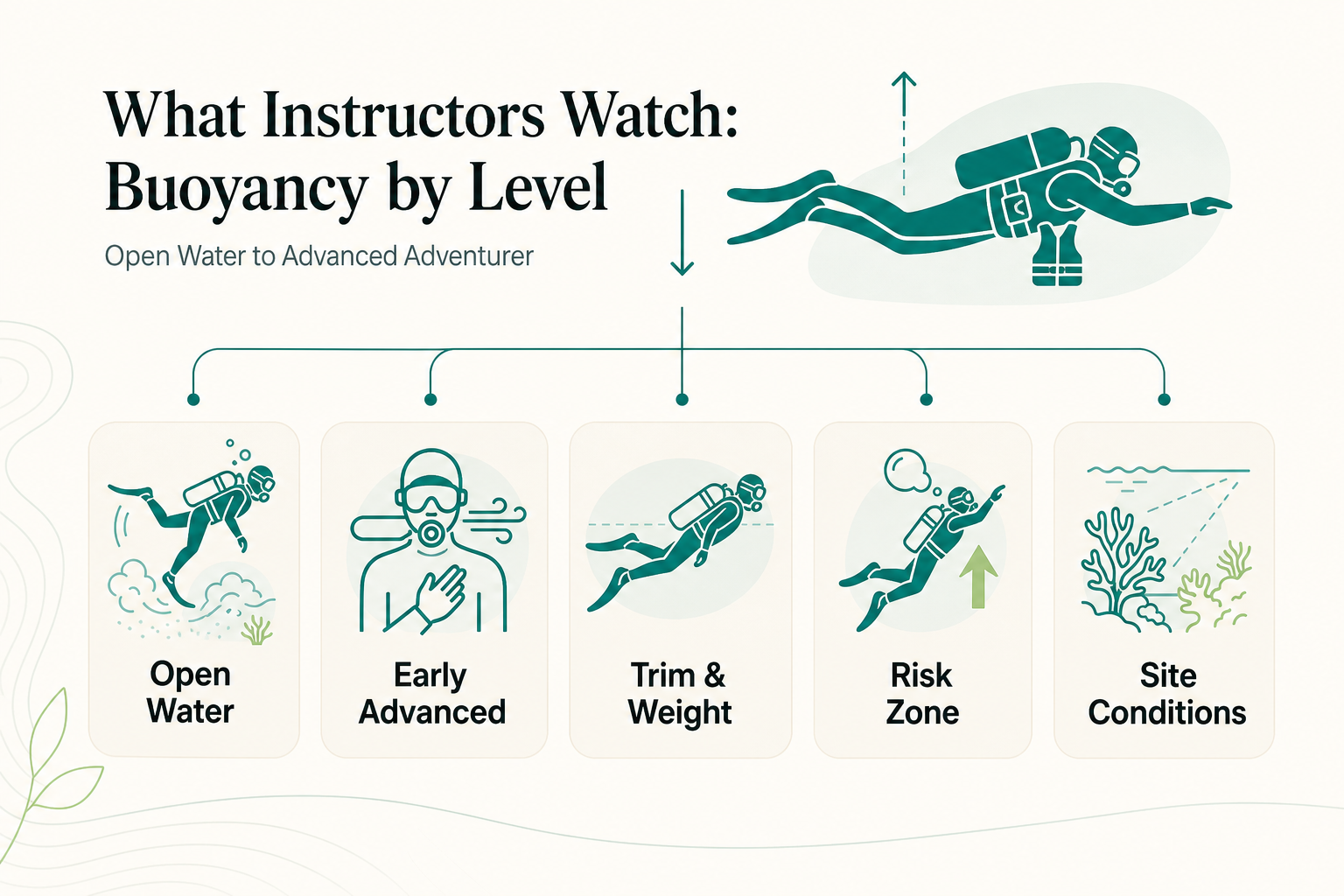
What Does an Instructor Actually Look For During a Student's First Open Water Dives?
At the Open Water level, instructors are watching for gross control, not finesse. The question is simple: can this diver stop kicking and stay at a stable depth for more than a few seconds?
Three things get flagged immediately:
- Fin-kicking to hold depth. If a student's legs are working while stationary, they are negatively buoyant and compensating with propulsion instead of air volume. That is the single most common early mistake instructors cite.
- Overshooting on the inflator. New divers tend to add air in bursts, drift up, panic, dump too much, and sink. Instructors are watching for the rhythm of adjustment, not just the end result.
- Breath-holding or shallow, erratic breathing. Anxiety shortens and speeds up breathing, which throws off the natural rise-and-fall a diver needs to fine-tune depth with lungs alone.
SSI's Open Water Diver course certifies a diver to operate independently to 18 meters, a limit set because it is the depth range where these skills can be practiced with a manageable margin for error. Supervised Scuba Divers, a step below Open Water, are capped at 12 meters for the same reason. The certification is not really about depth access. It is about proving the diver can manage their own buoyancy without a hand constantly on the inflator hose.
Why Does Trim Matter as Much as the Buoyancy Control Device Itself?
Neutral buoyancy and good trim are two different problems, and conflating them is where a lot of early instruction goes wrong. A diver can hold a stable depth and still swim head-up, feet-down, dragging fins through the sand or stirring up silt on a reef wall.
Trim is the horizontal orientation of a diver's body in the water, controlled primarily by weight placement, not air volume. Think of it like loading a canoe: if all the weight sits at the back, the bow rides high regardless of overall water displacement. A diver with weights concentrated on the belt and none distributed toward the tank or trim pockets will float head-up even at perfect neutral buoyancy.
Instructors evaluate trim because it exposes a buoyancy problem that inflator adjustments alone can hide:
- A feet-down diver often kicks downward to stay level, which is functionally the same as being negatively buoyant, just disguised by leg movement.
- Poor trim increases drag, which increases air consumption, which shortens dive time.
- On reef sites, vertical fin position is what causes contact damage. Horizontal trim keeps fins well above coral.
This is why instructors physically reposition tank height and weight distribution before a student ever enters open water, and why they keep checking it on the first few dives rather than assuming a confined-water fix holds.
How Does What Instructors Watch For Change at the Advanced Adventurer Level?
A diver who has logged 15 to 20 dives has usually stopped kicking to hold depth. The failure pattern shifts from gross control to fine control, and instructors adjust what they watch accordingly.
At this stage the checklist looks different:
| Skill focus | Open Water diver | Advanced Adventurer diver |
|---|---|---|
| Primary tool for depth changes | BCD inflator/deflator | Lung volume (breath control) |
| Typical error | Kicking to stay level | Overusing BCD for small adjustments |
| Depth range practiced | To 18m | To 30m, with deep diving adventure dive |
| Trim focus | Getting horizontal at all | Holding horizontal trim in current or overhead terrain |
| Instructor cue | "Stop kicking, use your BCD" | "Use your lungs, save the BCD for bigger changes" |
SSI's Advanced Adventurer course bundles five adventure dives, and completing the deep diving adventure dive extends a diver's operating depth to 30 meters. Full "Advanced Open Water Diver" recognition is a separate milestone: it is awarded automatically once a diver has completed four distinct specialty courses and logged at least 24 dives, not something booked as a standalone course.
The instructor's job at this level is to wean divers off constant BCD use for small depth corrections, since over-triggering the inflator on every breath is inefficient and creates the yo-yo pattern that wastes air and unsettles silt.
Why Do Buoyancy Mistakes Matter More Than They Look?
A wobbly hover looks like a minor technique issue. It is not always minor. Root cause analysis by Divers Alert Network attributes buoyancy control errors as the primary trigger in approximately 4% of recreational diving fatalities, most commonly through rapid, uncontrolled ascents.
An uncontrolled ascent is dangerous for a specific physical reason, not a vague one. As a diver rises, ambient pressure drops and gas trapped in the lungs expands. Held breath during a fast ascent can rupture lung tissue, causing arterial gas embolism, and rapid ascents from any meaningful depth raise decompression sickness risk by not giving off-gassing enough time. This is why instructors treat a student's inability to hold depth as a safety issue on day one, not a style preference to correct later.
Weighting compounds the risk. Overweighted divers add more air to the BCD, and more air in the BCD compresses and expands more dramatically with every meter of depth change, making buoyancy swings faster and harder to control. The standard fix is to weight a diver for neutral buoyancy at the safety stop with a near-empty tank, then build the rest of the dive plan around that baseline.
How Does Site Choice Affect How Fast a Diver Improves?
Site conditions either give a new diver room to make small errors safely or punish every mistake immediately. Strong current, low visibility, and overhead structure all shrink the margin for a wobbly hover.
Warm water with minimal current and good visibility lets a diver see their own depth drift against a reef wall in real time. Around Buka Buka Island in the Togean Islands, dive sites sit close enough to shore for short boat rides rather than long transfers. Visibility averages about 30 meters, which gives instructors a clear sightline to a student's fin position and trim from several meters away, something much harder to assess accurately in murkier water.
Frequently Asked Questions
What is a Buoyancy Control Device (BCD) and how is it different from breath control?
A BCD is the inflatable vest that holds a diver's air tank and lets them add or release air to change buoyancy. Breath control is a finer, faster adjustment method using lung volume, generally taught as the primary tool once a diver moves past basic Open Water skills.
What is the difference between scuba diving trim and buoyancy?
Buoyancy is whether a diver rises, sinks, or holds depth. Trim is the body's horizontal orientation in the water, controlled mostly through weight distribution rather than air volume.
How deep can a new Open Water diver go?
SSI's Open Water Diver certification permits autonomous diving to 18 meters. Supervised Scuba Divers, a lower certification tier, are limited to 12 meters.
Is the Advanced Open Water Diver a course I can book?
No. It is a recognition awarded automatically after completing four specialty courses and logging at least 24 dives. The bookable five-dive course after Open Water is called Advanced Adventurer.
About Reconnect
Reconnect is an eco-resort with an on-site SSI dive center on Buka Buka Island in Indonesia's Togean Islands, offering all-inclusive full-board stays from EUR 60/night alongside separately booked SSI courses taught in English, French, and Indonesian. The resort runs on 93% solar power with on-site desalinated water, and sits a short boat ride from reef, wall, and pinnacle dive sites. To plan a certification course or Dive-cation package, visit Reconnect.