


Solo diving is not automatically reckless, and buddy diving is not automatically safe. What matters is whether your certification level, dive count, and the site's remoteness actually support the choice you're making. In a place like the Togean Islands, where the nearest chamber facility is a long way from any reef, that calculation carries more weight than it would at a resort with a dive shop next to a hospital.
TL;DR
- SSI and PADI both mandate the buddy system as standard practice, built around pre-dive checks, shared air monitoring, and staying close enough to assist.
- Open Water divers are certified to 18 meters; Advanced Adventurer divers to 30 meters. Depth limits are not suggestions, they define what your training has prepared you for.
- Solo diving requires its own specific certification, extra gear (redundant air source, surface marker), and a logged dive count most Open Water divers don't yet have.
- Remote locations like the Togean Islands raise the stakes on both sides of the calculus: fewer boats nearby, longer response times, and reef sites reached by short rides rather than a five-minute swim from shore.
- Reconnect runs a guided, buddy-paired dive program from its on-site SSI center around Buka Buka Island, with training dives at nearby reef sites and instruction in English, French, and Indonesian.
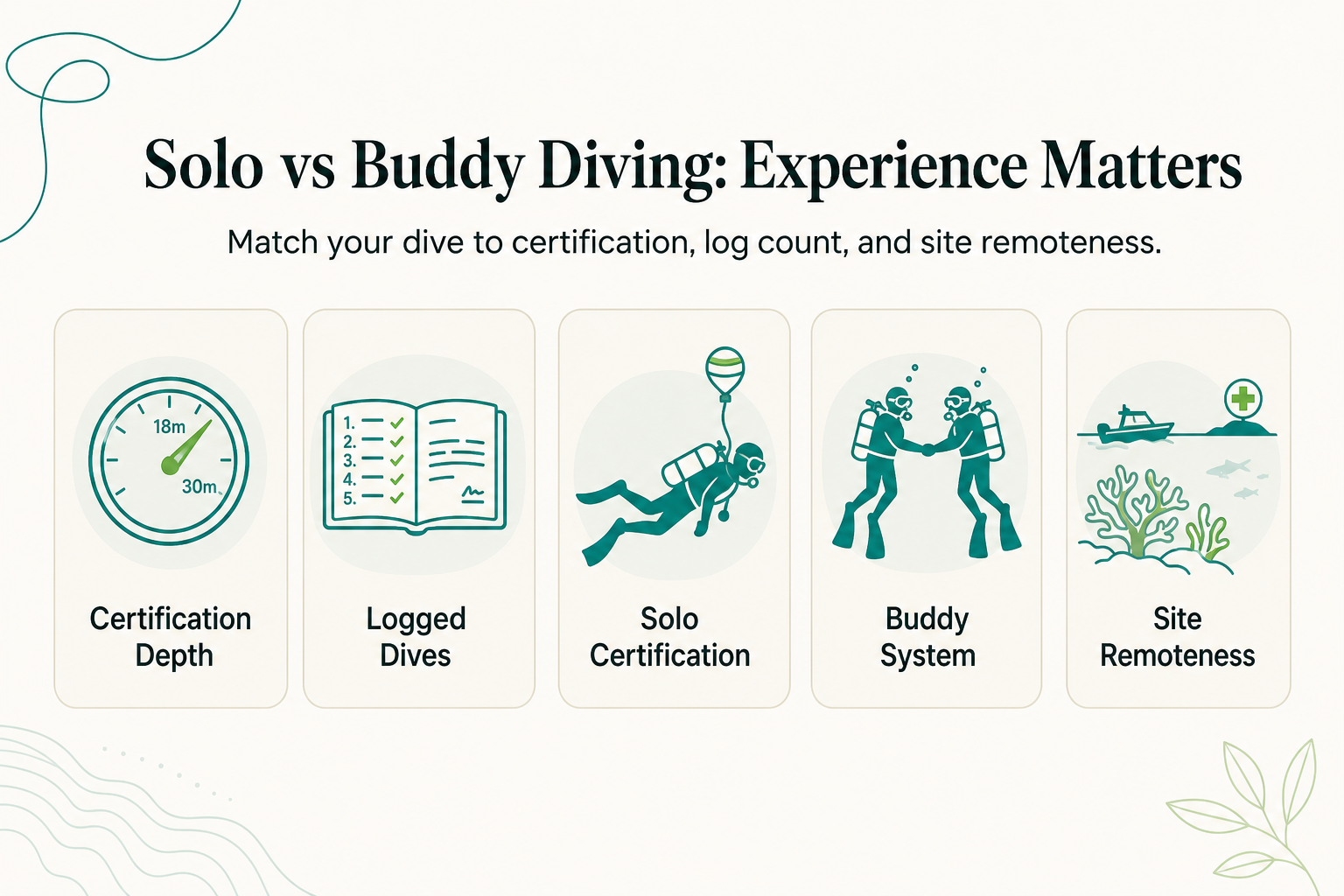
What Does the Buddy System Actually Require?
The buddy system is not "swim near someone else." It's a structured protocol: two divers plan the dive together, complete a pre-dive safety check on each other's gear, and stay close enough underwater to intervene if something goes wrong.
SSI and PADI both treat this as a mandatory standard, not a recommendation.
Most diving emergencies (out-of-air situations, entanglement, disorientation) are survivable if someone with a spare regulator is within arm's reach in the first 60 seconds. Past that window, the odds shift.
Standard scuba diving safety rules extend beyond the buddy pairing itself:
- Never exceed your certification's depth limit.
- Monitor air continuously, not just when you remember to check.
- Perform a three-minute safety stop at 5 meters before surfacing.
- Plan the dive, dive the plan, including a shared turnaround pressure.
These rules apply whether you're diving with a partner or, once appropriately trained, alone.
When Does Solo Diving Make Sense, and When Doesn't It?
Solo diving is its own certification track, not a default fallback for divers who'd rather not deal with a buddy. It exists because some divers genuinely want the self-reliance and the freedom from coordinating pace and air consumption with someone else.
The tradeoff is real, and it runs in both directions. A solo diver doesn't have to match a slower or faster buddy's pace, but they also don't have a second air source, a second pair of eyes, or backup if a mask strap fails at 20 meters. Solo certification programs address this by requiring:
- A minimum logged dive count well beyond entry-level certification.
- A redundant air source, typically a pony bottle or bailout cylinder.
- A surface marker buoy and reliable navigation skills.
- Demonstrated comfort managing an emergency without outside help.
Here's the honest framing most marketing skips: solo diving isn't "advanced diving," it's a different discipline with its own skill set. A diver with 200 logged dives who has never trained solo is not automatically ready for it. Conversely, a solo-certified diver with 60 dives may be better prepared for an unplanned separation than a buddy-paired diver with 300 dives who has never rehearsed being alone underwater.
How Does Experience Level Change the Calculus?
This is where the two research questions above collide. Certification level sets your depth ceiling; dive count and training determine whether solo diving is even on the table.
| Experience Level | Depth Limit | Buddy Requirement | Solo Diving Readiness |
|---|---|---|---|
| Open Water Diver | 18 m / 60 ft | Standard, always | Not typically recommended |
| Advanced Adventurer (5-dive course) | Up to 30 m depending on specialty dives completed | Standard | Still building the dive count solo cert requires |
| Advanced Adventurer rating (4 specialties + 24 logged dives) | 30 m / 100 ft | Standard, though experience supports better buddy judgment | Approaching eligibility depending on agency requirements |
| Solo-certified diver | Per underlying certification | Not required, but recommended in unfamiliar sites | Fully equipped and trained for it |
A beginner considering scuba diving for beginners courses should read that middle-right cell carefully: Advanced Adventurer training develops greater depth capability, not independence from a buddy. The two are separate qualifications solving separate problems.
In a place with reliable boat support and short response times to a chamber, an experienced diver stretching toward solo work has some margin for error. In a remote setting, that margin shrinks. This is the piece easy to gloss over in generic advice, and it's the reason location has to be part of the calculation, not just certification card.
Why Does Remoteness Change the Equation?
A dive site an hour from the nearest boat operator is a different risk environment than one five minutes from a fully staffed dive shop, even if the water, depth, and visibility are identical. The Togean Islands sit in this second category. Visibility here averages about 30 meters, among the clearest water in Indonesia, but clear water doesn't shorten the distance to help.
At Reconnect's on-site SSI dive center on Buka Buka Island, every reef site is a short boat ride away, not a long transfer. Training dives for courses happen at reef sites around the island, reached by a short boat ride, rather than on the house reef, which is reserved for complimentary snorkeling. That structure keeps instructor-to-diver ratios small and dive briefings specific to the day's conditions rather than generic.
This is also where a scuba diving safety rules argument gets concrete rather than abstract. In remote water:
- A buddy pair means a problem gets noticed and addressed within seconds, not minutes.
- Guided groups add a certified professional's judgment about current, depth, and site conditions on that specific day.
- Solo diving, even for a properly certified diver, means accepting a longer window before anyone else knows something is wrong.
None of this makes solo diving unreasonable everywhere. It does mean the calculus that works in a well-trafficked dive destination with dive boats passing every few minutes doesn't transfer cleanly to a remote reef system.
What Should a Diver Actually Do With This Information?
Match your dive plan to three things honestly: your certification's depth limit, your actual logged dive count (not your certification level alone), and the remoteness of the site you're diving. A newly certified Open Water diver on a remote reef should be buddy-paired and depth-limited to 18 meters, full stop. A diver working toward Advanced Adventurer training should treat those five dives as skill-building, not proof of independence.
Anyone seriously considering solo diving certification should do it through a proper course with the equipment and logged-dive prerequisites intact, then apply it selectively, favoring familiar or well-supported sites over remote first attempts.
Frequently Asked Questions
Is solo diving allowed at every certified dive center?
Policy varies by operator and site conditions. Even where solo diving is generally permitted, individual dive centers may require buddy pairing for specific sites, conditions, or diver experience levels.
What's the minimum certification to start Advanced Adventurer training?
You need an Open Water certification first. The five-dive Advanced Adventurer course builds skills toward the 30-meter depth range associated with advanced diving.
Can a beginner and an advanced diver buddy-pair together safely?
Yes, but the dive plan should follow the less experienced diver's certification limits and comfort level, not the more advanced diver's capability.
Does a dive computer replace the need for a buddy?
No. A dive computer tracks your own depth, time, and ascent rate. It does nothing to address an equipment failure, entanglement, or medical event that a buddy could otherwise respond to directly.
Why do some remote dive destinations discourage solo diving even for certified solo divers?
Response time. A remote reef with limited nearby boat traffic means any problem, solo-related or not, takes longer to reach help, which changes the risk math even for well-equipped solo divers.
About Reconnect
Reconnect is a private island eco-resort with an on-site SSI dive center in the Togean Islands, offering guided, buddy-paired reef diving, house-reef snorkeling, kayaking, and paddleboarding. Instruction available in English, French, and Indonesian. Get in touch through Reconnect.
References
- Solo Diving vs Team Diving: Risk, Freedom, and Responsibility (indepthmag.com)
- Dive Buddy vs. Solo Diving: Weighing the Pros and Cons for Safe and Enjoyable Dives (insidescuba.online)
- Book Solo, Dive as a Pair: How Scuba's Buddy Rule Works (siamdive.com)