


A dive computer set up for a brand-new Open Water diver and one set up for someone with 200 logged dives should not look the same, read the same, or even beep the same. The gap matters most in a place like the Togean Islands, where reef profiles invite divers to go deeper and stay longer than they planned. Matching gear to experience level is not a luxury step, it is the difference between a dive that builds confidence and one that creates a problem underwater.
TL;DR
- Beginner divers need large-screen, single-gas dive computers with simple two-button interfaces and conservative default settings.
- Advanced divers benefit from multi-gas, customizable computers with wireless air integration, but only once their training justifies the extra data.
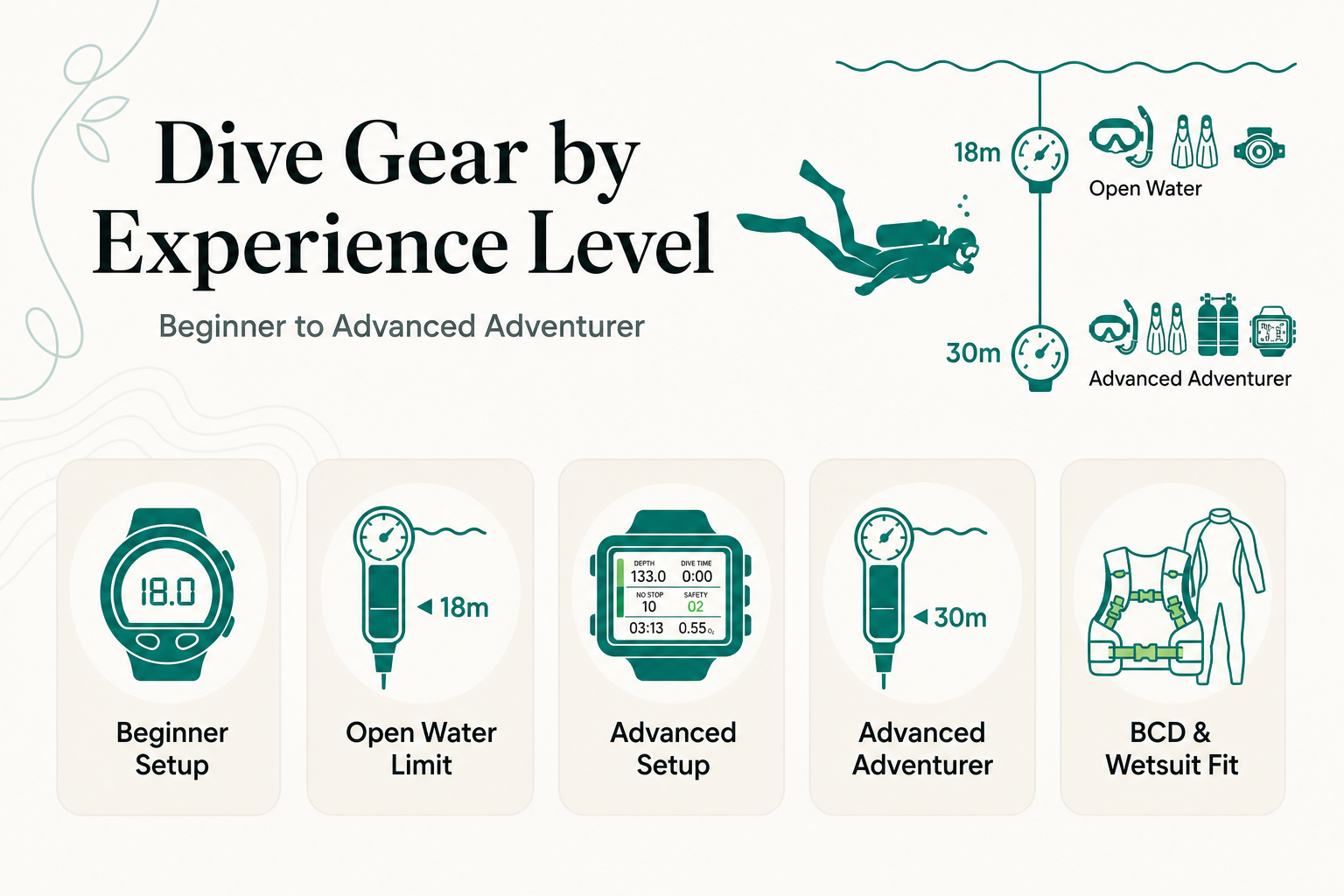
- SSI Open Water divers are capped at 18 meters; Advanced Adventurer certification raises that ceiling to 30 meters.
- Rental wetsuits and BCDs run XXS to 3XL, but fit checks matter more at entry level where buoyancy habits are still forming.
- At Reconnect, gear-room staff fit equipment by certification level before every dive, not just by body size.
Why Does Experience Level Change What Dive Computer You Need?
A dive computer tracks nitrogen absorption and calculates how long you can safely stay at a given depth. The underlying math is the same for every diver. What changes is how much control and how much raw data a diver can actually use without it becoming a distraction.
Beginner dive computers typically feature large, high-contrast LCD screens, single-gas capabilities for air or nitrox, and simplified single-button or two-button interfaces. That simplicity is deliberate. A new diver checking a screen for the first time at 12 meters needs to read remaining no-decompression time in under two seconds, not scroll through menus.
Advanced dive computers incorporate full-color OLED or TFT displays, multi-gas switching including trimix, wireless air integration, and customizable decompression algorithms. These features solve real problems for divers doing multi-tank days or technical profiles, but they add decision points a beginner does not yet need to manage.
The mechanism: a dive computer is only as useful as the diver's ability to interpret it under mild task-loading. Give a four-dive-logged beginner a six-button multi-gas computer and you have added a second thing to think about at exactly the moment they should be focused on buoyancy and air consumption. Simplicity at entry level is not a compromise, it is the correct engineering choice for where attention actually needs to go.
Beginner vs. Advanced Dive Computer: Side-by-Side
| Feature | Beginner Setup | Advanced Setup |
|---|---|---|
| Display | Large monochrome LCD | Full-color OLED/TFT |
| Gas switching | Single gas (air/nitrox) | Multi-gas, including trimix |
| Interface | 1-2 buttons | Multi-button or touchscreen |
| Air integration | Usually none | Wireless, often standard |
| Algorithm settings | Fixed, conservative | Customizable |
| Typical max depth relevance | 18m (Open Water limit) | 30m+ (Advanced Adventurer) |
How Should Rental Wetsuits and BCDs Fit at Each Level?
Dive centers typically stock rental wetsuits in standard unisex or gender-specific sizes ranging from XXS to 3XL, categorized by neoprene thickness such as 3mm or 5mm based on local water temperatures. In the Togeans, where surface water stays warm year-round, 3mm is the standard thickness most guests use.
Jacket-style rental BCDs come sized from XXS to XXL with adjustable shoulder, chest, and waist straps to fit various body types. Fit tolerance matters differently by experience level:
- New divers need a snug BCD with minimal air trapped in folds of material, since a loose fit makes buoyancy control harder to learn and masks early mistakes as "the gear's fault" rather than a skill to build.
- Experienced divers can compensate for a slightly imperfect fit using trim weights and breathing control, but still benefit from checking strap adjustment before every dive, not just the first one.
- Anyone wearing a rental BCD for the first time at a new center should do a buoyancy check in shallow water, regardless of how many dives they have logged elsewhere, because strap geometry varies between manufacturers.
A good analogy: renting a BCD is like renting a bicycle you have not ridden before. Your legs know how to pedal, but the gear ratio, brake position, and seat height are new, and five minutes of adjustment before the real ride prevents a wobble on the first hill.
What Belongs on a Beginner Dive Gear Checklist?
A first-timer walking into a gear room should expect the center to provide, size, and explain each of these before the briefing starts:
- Mask and snorkel, fitted for face seal, not just head size
- Fins, sized to boot or bare foot depending on wetsuit thickness
- 3mm wetsuit, full-length for warmth and minor scrape protection
- BCD, jacket-style, adjusted at shoulder, chest, and waist
- Regulator set with octopus (backup second stage)
- Single-gas dive computer, pre-set to recreational no-decompression limits
- Weight belt or integrated weights, adjusted after a buoyancy check
This list applies whether a guest is doing a Discover Scuba Diving course, a first confined-water session, or their first open-water training dives. Beginner scuba equipment should never be handed over as one standard bundle. Fit and function are checked item by item, because a poorly seated mask or an over-inflated BCD undoes a good briefing in minutes.
How Do SSI Course Levels Map to Deeper Diving?
SSI's Try Scuba and Basic Diver programs introduce beginners to diving with confined or open water dives up to 12 meters. The Open Water Diver certification requires online academics, confined water sessions, and four open water training dives, and it caps certified divers at 18 meters under both SSI and PADI standards.
The next step up, Advanced Adventurer, requires completing five different specialty dives and raises the depth limit to 30 meters. This is distinct from the SSI Advanced Open Water Diver recognition, which is awarded automatically once a diver completes four full specialty certifications and logs 24 dives, rather than something booked as a standalone course.
Gear should shift at each threshold. A diver moving from Open Water to Advanced Adventurer is also moving into depth ranges where no-decompression limits tighten and a more detailed computer display starts paying for itself. This is the point where upgrading from a rental unit to a personal dive computer for beginners graduating to intermediate status starts to make practical sense, rather than a marketing upsell.
Course training dives at Reconnect happen at reef sites around Buka Buka Island, reached by a short boat ride, separate from the complimentary house reef snorkeling available to all guests regardless of certification. Instruction is offered in English, French, and Indonesian.
Should You Rent a Dive Computer or Bring Your Own?
Dive computer rental makes sense for beginners and occasional divers who are not ready to commit to a personal unit, and most dive centers, including Reconnect's, stock rental computers calibrated to recreational limits. The tradeoff is familiarity: a rental unit's interface is new every trip, while a personal computer's menu logic becomes second nature after a few dives.
For divers doing a one-off trip or a Discover Scuba Diving course, rental is the practical choice. For anyone diving more than a few times a year, or anyone progressing toward Advanced Adventurer and multi-specialty work, owning a personal computer, even an entry-level one, builds the kind of familiarity that matters most exactly when task-loading increases: deeper water, longer dives, group logistics.
House reef snorkeling does not require any of this. It is complimentary for all guests at Reconnect, with masks, fins, and snorkels provided, making it the lowest-friction way to see the same reef system that divers are exploring a few meters deeper. For travelers weighing the best snorkeling Indonesia has to offer against a first scuba course, the two are not competing choices. Many guests do both on the same trip.
Frequently Asked Questions
Do I need my own dive computer for a Discover Scuba Diving course?
No. Discover Scuba Diving sessions are run with instructor supervision and center-provided rental computers set to conservative recreational limits.
What size range do rental wetsuits typically cover?
Standard rental stock runs from XXS to 3XL, in 3mm or 5mm neoprene depending on water temperature.
Can an Advanced Adventurer diver use a beginner dive computer?
Technically yes, but the single-gas, fixed-algorithm design does not support multi-gas or customizable profiles that become useful at 30-meter depths.
About Reconnect
Reconnect is a private island eco-resort with an on-site SSI dive center on Buka Buka Island in the Togean Islands, Central Sulawesi. Get in touch at reconnect.id to plan a trip matched to your experience level.