


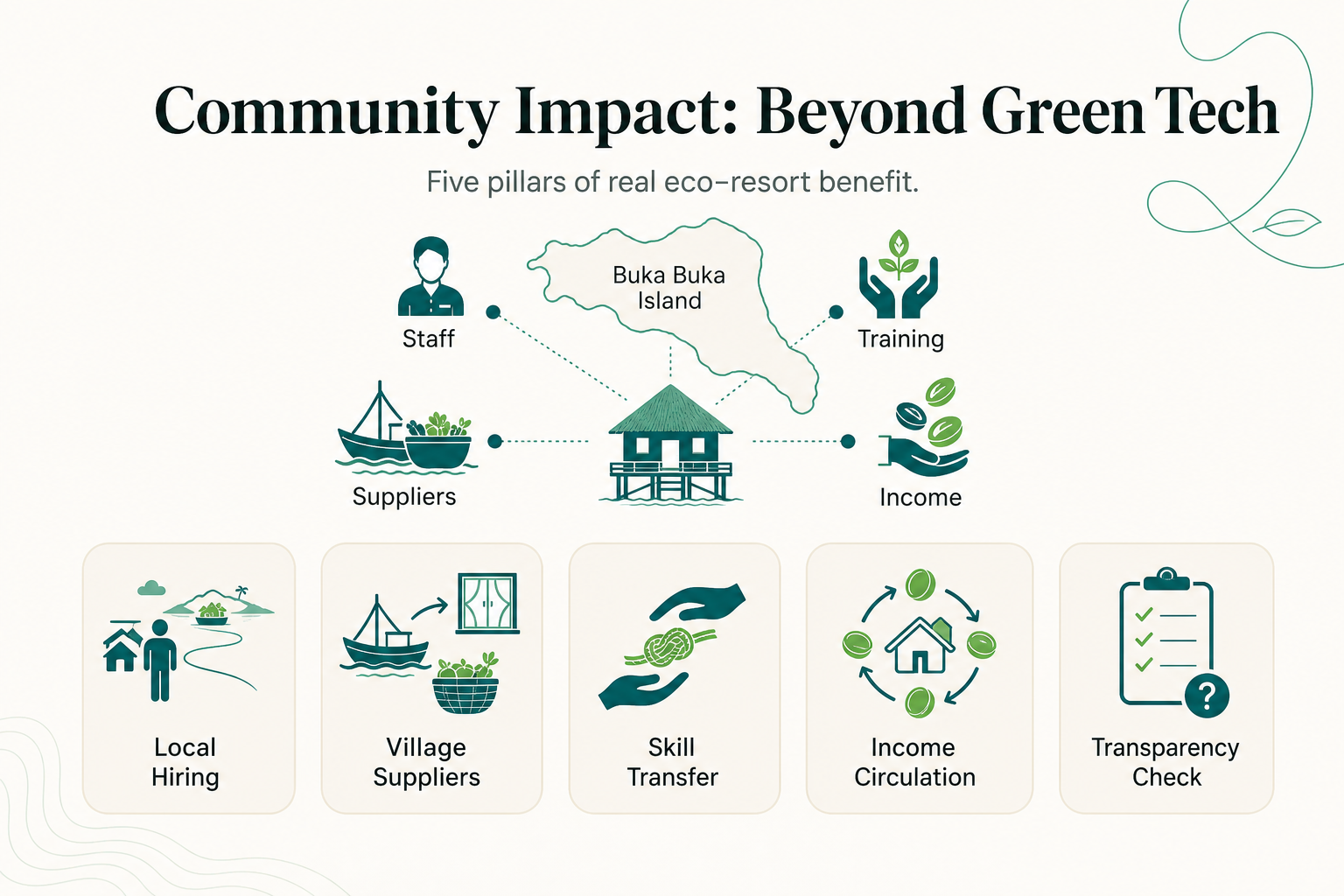
Most eco-resorts advertise solar panels and reef conservation. Fewer can show you a payroll built entirely from the nearest villages, or point to a specific fishing community that supplies the kitchen. The real measure of an eco-resort's impact is not its power source. It is whether the people who live there year-round are better off because the resort exists.
TL;DR
- Community-based ecotourism ties a resort's economic success directly to local income, job creation, and skills that stay in the region after guests leave.
- Village supplier partnerships (produce, fish, craft goods) keep guest spending inside the local economy instead of leaking to outside distributors.
- Studies of Indonesian village partnership models show real gains in income and conservation, alongside documented risks like uneven income distribution if the model is not managed carefully.
- Reconnect, an eco-resort in Indonesia's Togean Islands, hires its entire team locally and sources through neighboring village partnerships as a matter of operating structure, not marketing.
What Does "Community-Based Ecotourism" Actually Mean?
Community-based ecotourism is a model where the local population holds a direct economic stake in tourism activity, through employment, supply contracts, or shared decision-making, rather than serving as a backdrop for it. The distinction matters because plenty of resorts market "community connection" while importing staff and supplies from elsewhere.
When a resort hires from within a 10-kilometer radius and buys produce from village suppliers, guest spending recirculates locally instead of flowing to a regional distributor or an outsourced staffing agency. Research on Indonesian village partnership models documents measurable outcomes: increased local income, new job creation, and in several cases improved forest conservation when communities have a financial stake in intact ecosystems.
The same research is honest about failure modes. Village partnership models can produce unequal income distribution if only a few households capture the benefit, and non-transparent decision-making if the resort operator controls who gets hired or paid. The model only works with genuine multi-stakeholder coordination.
Why Does Staff Origin Change the Guest Experience, Not Just the Payroll?
Staff origin shapes what a guest experiences on the ground. Local knowledge cannot be trained into an outside hire in a few weeks.
A dive guide who grew up fishing the waters around Buka Buka Island knows which channel runs calm at low tide and which pinnacle holds current on a full moon. A staff member from a Bajo village can explain what a house post pattern signals about a family's fishing rights, not a tourist-brochure version. This is the difference between performance and structural authenticity.
There is an economic argument too:
- Local hiring removes the cost and disruption of importing labor to a remote island, where housing and transport for outside staff add overhead.
- Villagers hired as boat crew, guides, or kitchen staff gain transferable skills such as English-language communication and food safety practice.
- Retention tends to be higher when staff live near family and community, reducing churn that undermines service quality at remote properties.
None of this replaces training standards. It sits alongside them.
How Do Village Supplier Partnerships Work in Practice?
A village supplier partnership is a recurring purchase arrangement in which a resort buys goods or services directly from a nearby community, rather than through a wholesale distributor. In an eco-resort context this most often covers fresh produce, fish, and handmade goods.
| Element | Typical distributor route | Village partnership route |
|---|---|---|
| Fish and seafood | Regional wholesale supplier | Direct purchase from village fishing crews |
| Produce | Trucked or shipped in from a regional hub | Sourced from nearby farming households |
| Craft and textile goods | Imported souvenir stock | Commissioned from village artisans |
| Income destination | Outside the immediate region | Circulates within neighboring communities |
A fish sold to the resort kitchen at a fair price is money earned without a middleman markup, and it is money spent at the village's own shops. Authentic eco-lodges combine local hiring with local sourcing, because one without the other leaves half the economic benefit on the table. The strongest ecotourism operators treat community benefit as core business.
What Should a Traveler Actually Check Before Trusting an "Eco" Claim?
Most resorts can point to solar panels or a recycling bin. Fewer can answer three specific questions.
Step 1: Ask what percentage of staff is hired locally.
A resort that cannot give a number likely has not built its operation around local hiring in a structural way.
Step 2: Ask which villages the resort sources from, by name.
Local sourcing frameworks that hold up under scrutiny name specific communities and specific goods, not a general claim of "supporting the local economy."
Step 3: Ask whether village visits are extractive or reciprocal.
A village visit with no purchase, employment link, or genuine exchange is tourism performance rather than community-based ecotourism.
Even well-structured partnerships require deliberate management to avoid concentrating income in a few connected households. A traveler cannot verify internal income distribution from a website, but they can ask a direct question at check-in and see how specific the answer is.
How Does This Apply to an Island Resort in a Remote Archipelago?
An island resort in Indonesia faces a sharper version of this question than a mainland property does, because there is no larger town nearby to absorb the labor market or produce supply chain. Every hire and every ingredient is a deliberate choice about which community benefits.
At Reconnect on Buka Buka Island in the Togean Islands, staffing and sourcing follow that logic directly. The entire team is hired from neighboring communities, and supplier relationships run to nearby villages rather than a regional wholesale network. The dive center's daily boat runs and the kitchen's produce deliveries depend on that local structure functioning well, which is why service quality depends on stable local employment rather than rotating outside staff.
The Village Visit excursion to nearby Bajo communities is a deliberate extension of that relationship: an introduction to a culture the resort's own staff come from, not a staged detour. Combined with 93% solar power, on-site desalinated water, and a zero single-use plastics policy, the local hiring and sourcing model is one piece of a wider operating decision to build the resort around the island and its neighboring communities.
Frequently Asked Questions
Does hiring locally cost an eco-resort more than importing staff?
Not typically. Housing, transport, and turnover costs for imported labor on a remote island usually exceed the cost of hiring and training locally, though upfront training investment can be higher initially.
Can a resort be community-based without local ownership?
Yes. Local ownership is one model, but a foreign-owned resort with genuine local hiring, supplier partnerships, and transparent income sharing can deliver comparable community benefit.
How can a guest verify a resort's local hiring claims while booking?
Ask directly for a staff origin breakdown and named village suppliers. Specific, named answers indicate a real structure; vague answers indicate marketing language.
Does community-based ecotourism guarantee positive conservation outcomes?
No. Documented research shows conservation gains are common but not automatic, and depend on transparent, well-distributed economic benefit across the community.
About Reconnect
Reconnect is an eco-resort with an on-site SSI dive center on Buka Buka Island in the Togean Islands, featuring 20 rooms, full off-grid solar power, and an all-inclusive full-board model from EUR 60 per night. The entire team is hired from neighboring communities, and kitchen and craft supplies run through partnerships with nearby villages. Guests dive and snorkel on reefs within the Togean Islands while staying at a resort structured around the people who call this archipelago home. Learn more at Reconnect.