


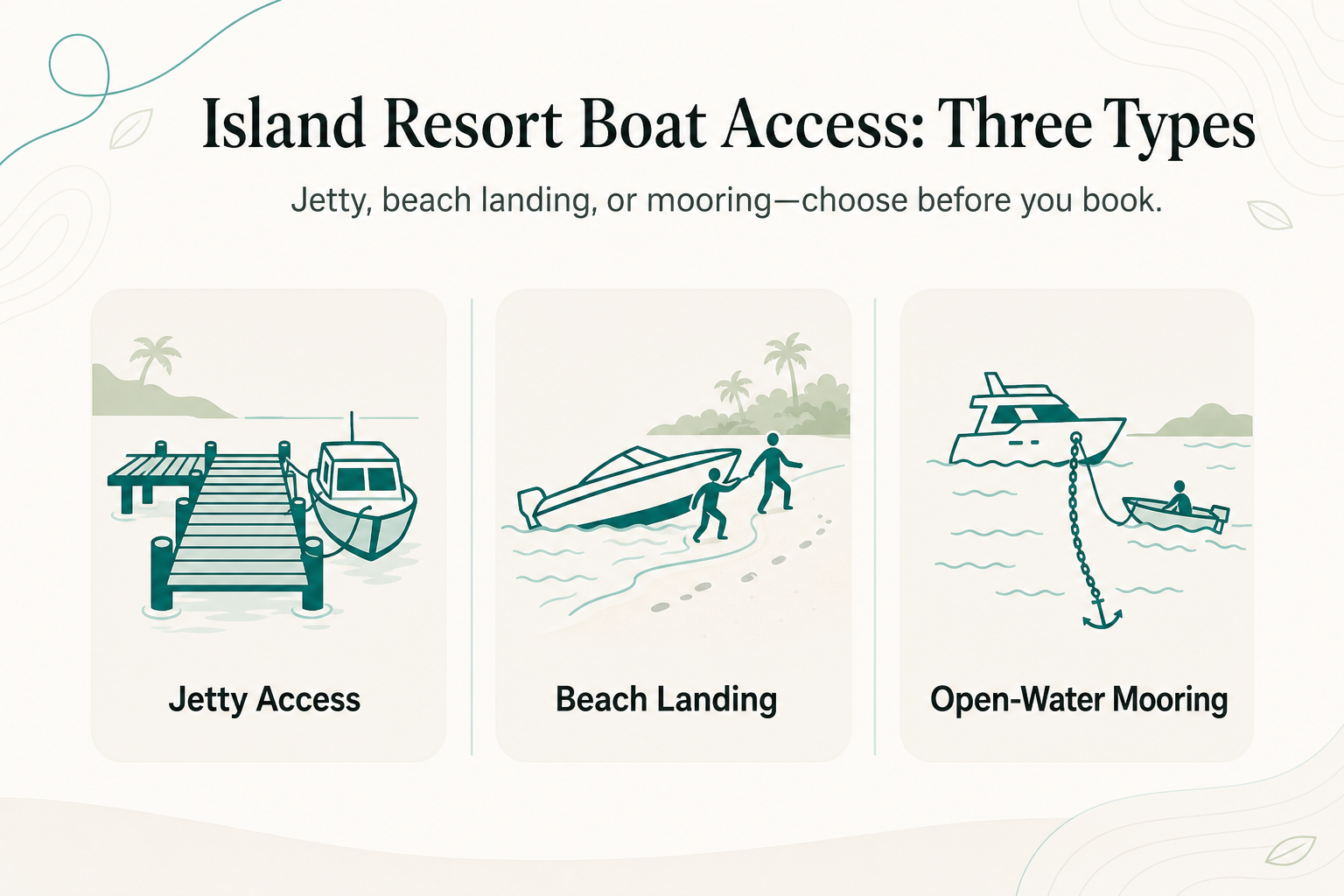
The way a boat reaches an island resort tells you more about your actual stay than almost any photo on its website. A concrete jetty, a beach landing, and an open-water mooring each carry different implications for luggage, timing, sea conditions, and how often you can get on and off the island once you arrive. Get this detail wrong when shortlisting, and you can end up with a dream resort that is routinely cut off from its own guests for days at a time.
TL;DR
- Jetty access gives the most predictable, weather-resistant arrival: boats dock directly, so luggage, mobility-limited guests, and night arrivals are all manageable.
- Beach landing means the boat noses onto sand and you step off into shallow water. Fine for light bags and calm seas, harder in swell or with heavy dive gear.
- Open-water mooring means the boat anchors offshore and a tender or swim brings you in. This is the most weather-dependent option and the one most likely to cause delays.
- Ask any resort directly which of the three applies, since this detail is rarely volunteered on a website.
Why Does Boat Access Matter More Than Most Travelers Assume?
Boat access determines whether a resort functions in rough weather or stops functioning. A property reached by open-water mooring in an exposed bay can lose a full transfer day when wind picks up. A jetty in a sheltered channel usually keeps running.
It is infrastructure, and it behaves the same way any other piece of infrastructure does: the more intermediate steps between transport and arrival, the more points where delay can enter. A jetty removes a step. A mooring adds one.
Most resort websites show arrival photos, not arrival mechanics. You generally have to ask.
What Are the Three Boat Access Types, and How Do They Actually Work?
Option 1: Jetty Access
A jetty is a fixed structure, usually wood or concrete, extending from shore into water deep enough for a boat to dock alongside it directly.
- Guests step off onto a stable platform, no wading required.
- Luggage and dive equipment can be wheeled or carried off without getting wet.
- Jetties tend to work in a wider range of tide and swell conditions than a beach landing.
- Night arrivals are far more manageable since there's a fixed, lit structure to aim for.
This is the access type you want if you are traveling with hard-case dive gear, have any mobility concerns, or are arriving after dark.
Option 2: Beach Landing
A beach landing means the boat approaches the shoreline directly and either beaches on sand or stops in water shallow enough to wade from.
- Works well in calm, low-swell conditions and with light luggage.
- Avoids the cost and maintenance of a permanent jetty structure.
- Becomes genuinely difficult with surf, a steep beach gradient, or heavy equipment like dive tanks and camera housings.
- Timing around tide matters more here than at a jetty, since very low tide can leave boats stranded far from dry sand.
Beach landing suits travelers packing light who are comfortable getting their feet, and occasionally their bags, wet.
Option 3: Open-Water Mooring
Here the main boat anchors offshore in deeper water and guests transfer to shore by tender, smaller skiff, or in rare cases a short swim.
- Adds an extra transfer leg to every arrival and departure.
- Common for resorts where the shoreline is too shallow or too reef-lined for anything to approach directly.
- Generally the slowest and least predictable option when conditions turn.
If a resort uses open-water mooring, ask specifically what happens when conditions prevent the tender from running. The honest answer, for most properties, is that guests wait.
How Should You Actually Shortlist by This Criterion?
A related but distinct question from understanding the three types is how to use them practically when comparing resorts. Treat boat access as a filter you apply before you look at rooms or rates, not after.
| Access Type | Weather Resilience | Luggage/Gear Handling | Best For |
|---|---|---|---|
| Jetty | High | Easy, dry handling | Dive gear, mobility needs, night arrivals |
| Beach landing | Medium | Manageable if light, wet feet likely | Light packers, calm-season travel |
| Open-water mooring | Low | Extra transfer step required | Resorts where no direct approach exists |
Step 1: Ask the resort directly which type applies.
Do not infer this from marketing photos. Email or message and ask: "Is the boat transfer by jetty, beach landing, or offshore mooring?" A resort confident in its infrastructure will answer in one sentence.
Step 2: Ask what happens in rough weather.
This is the real stress test. A resort with a jetty in a sheltered channel will usually say transfers continue as normal. A resort relying on open-water mooring in an exposed bay should be honest that transfers can be delayed.
Step 3: Match the answer to your gear and group.
Traveling with dive equipment, young children, or anyone with mobility limits pushes you firmly toward jetty access. Light solo travel in calm season tolerates a beach landing fine.
How Does This Apply Specifically to the Togean Islands?
The Togean Islands sit in a stretch of Central Sulawesi where most island properties, including resorts on islands such as Una Una, Malenge, and Kadidiri, rely on boat transfer as the only way in. There is no single standard for how that transfer ends at the shoreline, and it varies property to property.
Reconnect, on Buka Buka Island, uses direct jetty access as the final step of a coordinated transfer: private car from Luwuk Airport to Ampana, then a private speedboat of 30 to 45 minutes to the island. Guests dock directly rather than wading or tendering in.
Frequently Asked Questions
Does jetty access cost more than beach landing or mooring?
Access type is a function of the shoreline and infrastructure a resort has built, not a pricing tier. Properties at a wide range of rates use each of the three.
Can a resort change its boat access type seasonally?
Tide and swell conditions can make a beach landing or mooring harder at certain times of year, but the underlying infrastructure, jetty, beach, or mooring point, stays fixed.
Is open-water mooring always a sign of a less developed resort?
No. Some shorelines are too shallow or too reef-protected for any direct approach, and mooring with a tender is the only workable option regardless of how developed the resort itself is.
How do I find this information if a resort's website doesn't mention it?
Ask directly before booking. It is a one-sentence question and any resort that handles its own transfers should be able to answer it immediately.
About Reconnect
Reconnect is a private island eco-resort with an on-site SSI dive center on Buka Buka Island in the Togean Islands. For details on transfers, rooms, or booking, visit reconnect.id.