


Almost every remote destination markets itself as a "hidden gem," and almost none define what that actually means. Travel industry bodies have no fixed criteria for the term. They generally point to emerging, under-the-radar destinations with strong cultural and natural value, physical isolation, limited infrastructure, and low visitor numbers, evaluated through frameworks like sustainability and cultural preservation standards. Without a shared standard, the label becomes whatever a marketing team wants it to mean. This article gives you five concrete checks to run before you trust the claim, using the Togean Islands as a working example throughout.
TL;DR
- "Hidden gem" has no fixed industry definition. Treat it as a hypothesis to test, not a fact to accept.
- Check isolation with hard numbers: flight frequency, transfer time, road access.
- Check infrastructure honestly: power source, water source, connectivity, room count.
- Check ecological and cultural substance: protected status, biodiversity data, local employment.
- Check visitor volume trends, not just current quiet.
- The Togean Islands score well on all four because of geographic remoteness, UNESCO Biosphere Reserve status since 2019, and consistently low visitor density.
About the Author: Reconnect operates an eco-resort in the Togean Islands, one of the destinations most frequently labeled a hidden gem in Indonesian travel content. We built this framework from the same due-diligence questions our own guests ask before booking a place they have never heard of.
What Does "Hidden Gem" Actually Mean in Travel Marketing?
The phrase has no enforced definition. Any operator can use it, which is exactly why it needs verification rather than trust.
The closest thing to an official framework comes from sustainability and cultural preservation standards evaluated by international tourism bodies. That distinction matters. A place isn't a hidden gem just because few people have heard of it. It's a hidden gem when isolation coexists with genuine natural or cultural value that hasn't been diluted by mass tourism yet.
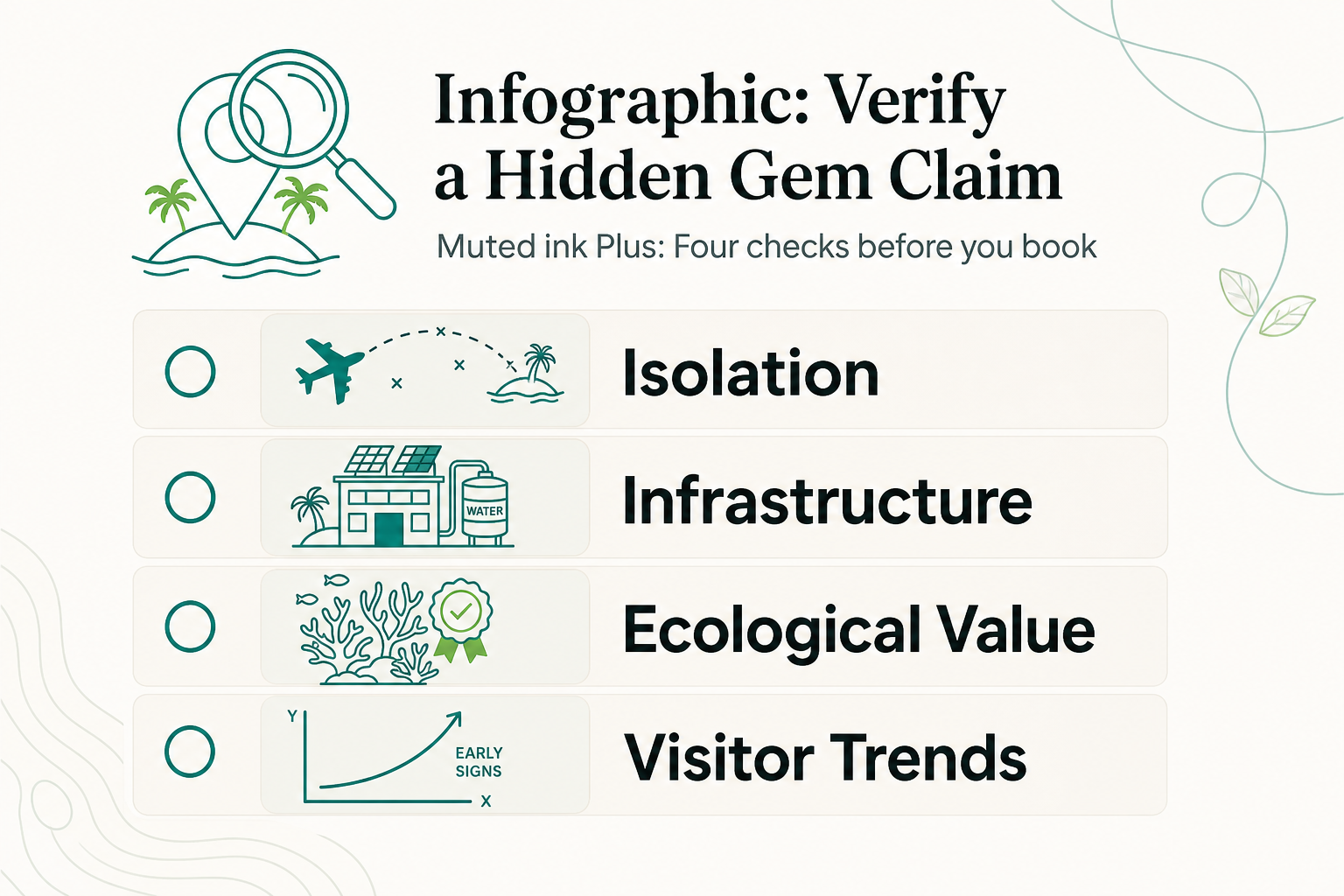
That gives us a working definition: low visitor volume, meaningful cultural or ecological substance, and infrastructure that hasn't scaled to match. Four checks follow from that.
Check 1: Is the Isolation Real or Just Marketed?
Isolation is measurable. It shows up in flight frequency, transfer duration, and the number of legs required to arrive, not in how a listing describes the view.
Run this test on any destination:
- Flight frequency to the nearest airport. Daily service signals an established route. Twice-weekly or less signals genuine remoteness.
- Number of transfer legs after landing. One flight plus one car ride is accessible. Flight, then five-hour drive, then boat crossing is a different category of remote.
- Total door-to-door time. A destination that takes half a day to reach from the nearest airport filters out casual visitor traffic by default.
The Togean Islands sit in the Gulf of Tomini, within Tojo Una-Una Regency in Central Sulawesi. Reaching them typically means a flight into a regional gateway, a road transfer of several hours, and a speedboat crossing to the island itself. These concrete steps, not marketing language, are what keep visitor numbers low.
Check 2: Does the Infrastructure Match the "Untouched" Story?
This is where most hidden gem claims fall apart. A destination can be geographically remote and still be built out with grid power, municipal water, and hundreds of rooms, in which case "untouched" is doing a lot of unearned work.
Ask these questions before booking:
| Infrastructure signal | What it tells you |
|---|---|
| Power source (grid, generator, solar) | Solar-first setups signal self-sufficiency planning; generator-reliant sites often have inconsistent power |
| Water source (municipal, trucked-in, desalinated) | Trucked-in water usually means higher environmental cost per guest |
| Internet connectivity | Starlink or satellite in a remote area is a genuine engineering choice, not a given |
| Room count | Under 30 rooms keeps guest density low regardless of destination size |
| Single-use plastic policy | A concrete, checkable operational choice, not a slogan |
On Buka Buka Island, we run at 93% solar power with generator backup only. Water is desalinated and produced on-site rather than trucked in. Starlink connectivity runs alongside that off-grid setup. The resort is deliberately small, 20 rooms across 8 accommodation types, and we operate a zero single-use plastic policy throughout. Each of those is verifiable on arrival. That's the difference between an infrastructure claim and an infrastructure fact.
Check 3: Is There Ecological or Cultural Substance Behind the Claim?
Remoteness alone doesn't make a destination worth the extra travel time. The isolation needs to be protecting or preserving something.
Look for a designation you can check independently: UNESCO status, national park boundaries, a marine protected area, or a recognized cultural heritage listing. The Togean Islands were recognized as a UNESCO Biosphere Reserve in 2019 and are officially designated as Togean Islands National Park. That's a third-party confirmation, not a resort's self-description.
The marine environment backs it up with specifics rather than adjectives. Dive sites here feature visibility averaging about 30 meters, deep walls, isolated coral atolls, barrier reefs, and even a WWII B-24 bomber wreck, all within the Coral Triangle's biodiversity zone, with schooling barracuda and reef sharks regularly sighted. Sites like these rank among the best snorkeling Indonesia has to offer specifically because the reef systems have had limited diver and boat traffic to date.
Cultural substance is checkable too. Nearby Bajo communities, sea nomad villages built partly over water, represent a living culture rather than a staged photo opportunity. A village visit that involves an actual supplier relationship, not just a drive-through, is a reasonable proxy for whether local economic value is real.
Check 4: Are Visitor Numbers Actually Low, or Just Low for Now?
A destination can be a genuine hidden gem this year and lose that status within two or three seasons if infrastructure scales faster than the ecosystem or community can absorb.
Watch for these early warning signs when researching a destination:
- New large-capacity resorts (100+ rooms) announced or under construction nearby
- Direct flight routes recently added or expanding in frequency
- Social media geotagging volume climbing sharply year over year
- Local infrastructure projects (roads, ports) explicitly framed around tourism growth
None of these are disqualifying on their own. But a cluster of them means the "hidden" part of hidden gem has an expiration date. This is why small-scale, deliberately capped accommodation, rather than infrastructure built for future expansion, is one of the more honest signals an operator can offer.
How Do You Apply This Framework Before You Book?
Run the four checks in order: isolation, infrastructure honesty, ecological or cultural substance, visitor trend trajectory. A destination that passes all four is doing more than marketing a feeling. It's describing a verifiable position.
When evaluating any remote destination or eco-resort in Indonesia, the same checks apply regardless of format. Full-board pricing, dive center certification, and transfer logistics are all facts you can request and confirm before arrival, not impressions to take on faith. Authentic travel experiences are the ones where the marketing survives contact with the checklist.
Frequently Asked Questions
Is "hidden gem" a protected or certified travel term?
No. There's no governing body that certifies a destination as a hidden gem. International tourism frameworks evaluate sustainability and cultural preservation but don't issue a "hidden gem" label specifically.
What's the fastest way to spot a fake hidden gem claim?
Check whether the operator publishes hard numbers, transfer times, room counts, power source, visitor data. Vague sensory language with no verifiable specifics is the most common tell.
Does UNESCO Biosphere Reserve status guarantee low tourist traffic?
No. It confirms ecological significance and conservation framework, but visitor volume depends on accessibility and marketing, which is why isolation still needs to be checked separately.
Are sustainable travel destinations automatically less crowded?
Not automatically. Sustainability practices and low visitor density often correlate, but a destination can market sustainability credentials while still scaling guest volume aggressively.
How do I check Togean Islands accommodation options for authenticity?
Look for published specifics: room count, power and water source, dive center certification, and staffing practices. Operators with nothing to hide typically state these plainly rather than in general terms.
About Reconnect
Reconnect is a Private Island Resort and on-site SSI dive center on Buka Buka Island in the Togean Islands, Central Sulawesi. We run 20 rooms across 8 accommodation types starting from EUR 60 per night, all-inclusive full board, powered 93% by solar with desalinated water produced on-site. Founded by Thomas Despin, the resort delivers direct reef access and a genuinely small guest footprint.
If you're weighing a remote destination against this framework, start with ours. Visit Reconnect to check the specifics yourself before you book.
References
None.