


Most guests planning a stay at a remote island resort ask about flights, room rates, and dive sites. Almost nobody asks how their phone gets charged, where a wet swimsuit dries overnight, or whether a midday nap will actually leave them rested. These are the details that quietly shape a trip once you arrive, and remote, off-grid properties handle them differently than a city hotel does. At Reconnect, an island eco-resort with an on-site dive center on Buka Buka Island in the Togean Islands, these questions come up constantly from guests mid-stay, which is exactly why they deserve answers before you pack.
TL;DR
- Off-grid resorts run on solar microgrids that easily charge phones, cameras and laptops, but typically cannot support hair dryers or kettles because of surge limits on the inverters.
- Laundry at remote island properties is usually slower and water-conscious, following practices like greywater recycling and towel reuse rather than same-day turnaround.
- A genuine power nap is 10 to 20 minutes, taken early in the day, if you want to fight travel fatigue without wrecking your sleep schedule.
- Starlink has made real-time connectivity possible on islands that had none five years ago, but it is not the same as fiber broadband and guests should plan accordingly.
- Reconnect runs on 93% solar power with battery backup, offers Starlink connectivity resort-wide, and two of its eight accommodation types include air conditioning, a rarity in the Togean Islands.
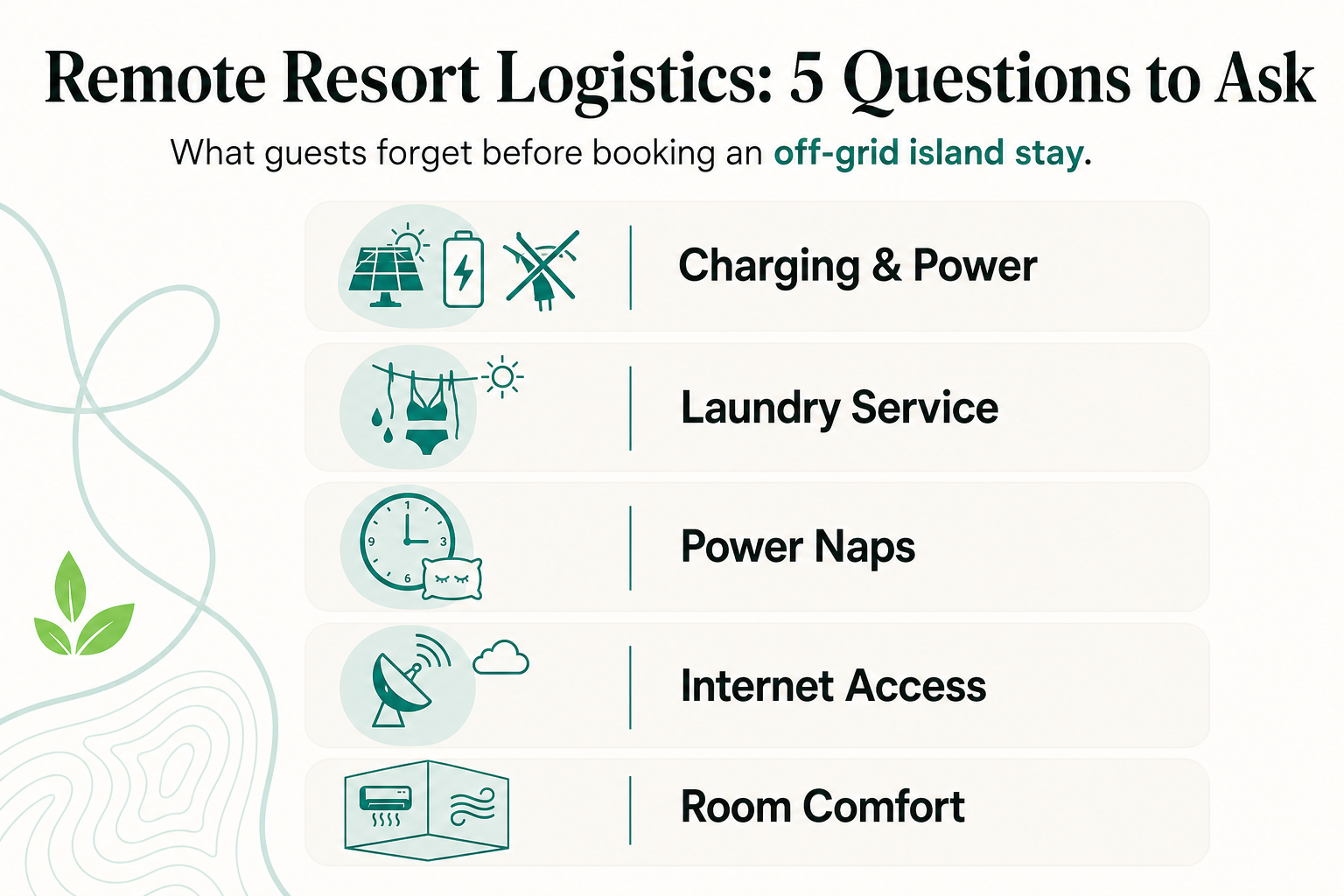
How Does Charging Actually Work at an Off-Grid Resort?
Photovoltaic panels feed battery banks, and inverters convert that stored power into usable AC electricity. The bottleneck is the inverter's maximum output, not the battery capacity.
That's why most off-grid properties, including many in remote parts of Indonesia, restrict high-wattage appliances. Hair dryers and electric kettles pull a heavy surge for a short burst. Phones, laptops, cameras, and drone batteries draw far less power and charge without issue.
What this means for packing:
- Bring your own charging cables and a multi-port USB adapter. Room outlets exist, but shared power strips are less common than in a standard hotel.
- Skip the travel hair dryer and kettle unless the property specifically confirms it supports them.
- A portable power bank is worth packing for boat excursions or day trips where you won't be near an outlet for several hours.
- Charge overnight when demand across the resort is lowest, and treat morning as a buffer if you need a full battery before a dive or excursion.
Reconnect runs 24/7 on solar power with battery backup, at 93% solar overall, with a generator kept strictly as backup. Guests charge phones, laptops, and camera gear throughout their stay without restriction. High-draw appliances like hair dryers are not part of the room setup, consistent with how solar microgrids are engineered to run.
Will My Laundry Actually Get Done, and How Fast?
Laundry service exists at most remote resorts, but the turnaround and process differ from what a city hotel guest expects. Water is often the limiting factor on an island. Many off-grid properties follow water-conservation frameworks using greywater recycling, high-efficiency washers, and towel reuse programs.
That has practical consequences for guests:
- Turnaround is typically 24 to 48 hours, not same-day, since laundry runs in batches to conserve water and energy.
- Quick-dry travel fabrics fare better than heavy cotton, which takes longer to dry in humid conditions without machine dryers.
- Packing two to three swimsuits and quick-dry layers reduces laundry needs, the simplest fix for a multi-day dive or snorkeling stay.
On islands without municipal water, laundry and drinking water both depend on on-site production. Reconnect desalinates and produces its own drinking water on-site, entirely sun-powered. Laundry and daily water use don't compete with a scarce trucked-in supply the way they might elsewhere in the Togeans.
Is a Midday Nap Actually Worth It, or Will It Wreck My Sleep?
Sleep scientists recommend keeping naps between 10 and 20 minutes. That is long enough to reduce fatigue but short enough to avoid deep sleep, which causes the groggy, disoriented feeling known as sleep inertia.
Timing matters as much as duration. For travelers adjusting to a new time zone, naps taken early in the day relieve tiredness without pushing back the natural bedtime. A 4pm nap after a long transfer is most likely to leave you wide awake at midnight.
For a Togean Islands stay specifically, most itineraries start with a genuinely long travel day: flight into Luwuk, a road transfer to Ampana, then a speedboat crossing to the island. Arriving mid-afternoon and staying awake until a reasonable local bedtime is the more reliable way to reset your schedule.
Does Connectivity Actually Work, or Am I Really Off the Grid?
Starlink has changed what "remote" means for satellite-based connectivity, delivering real-time internet to islands that had none reliably five years ago. It is not the same as fiber broadband.
Expect solid speeds for messaging, browsing, and video calls. Occasional dips occur during heavy cloud cover or peak resort-wide usage.
Reconnect offers Starlink connectivity throughout the resort, a genuine outlier for a fully off-grid property in this part of Indonesia. Guests can post from the reef the same afternoon they dive it. Remote workers can join a call without leaving the island. It sits alongside, not instead of, the resort's solar and desalination systems, each running independently.
What Other Small Comforts Should I Ask About Before Booking?
Air conditioning is the comfort question guests most often forget to ask. Not every room at every off-grid property has it. Among Reconnect's eight accommodation types, the Beachfront Villa and Villa Athena include AC, making Reconnect one of very few properties with air-conditioned rooms anywhere in the Togean Islands. The rest of the resort, including the Beachfront Glamping Hut and Pyramid options from EUR 60 per night, relies on natural ventilation and island breeze.
A few other details worth a direct question to any remote property, Reconnect included:
- Whether all meals and drinking water are included in the nightly rate, or billed separately.
- Whether snorkeling gear and kayaks are complimentary or a paid add-on.
- How transfers from the mainland airport to the resort are coordinated, and whether that's handled for you or left to arrange independently.
Frequently Asked Questions
Can I charge a laptop and camera batteries at the same time in an off-grid resort room?
Yes. Low-draw electronics like laptops, phones, and camera batteries are exactly what solar microgrids are built to support. The restriction is on high-surge appliances, not multiple simultaneous low-power devices.
How long should I expect to wait for laundry at a remote island resort?
Plan on 24 to 48 hours in most cases, driven by water-conservation batching rather than staffing delays.
Is a 20-minute nap really better than an hour?
Yes, for restoring alertness without grogginess. An hour-long nap risks entering deep sleep, which produces sleep inertia on waking.
About Reconnect
Reconnect is an island eco-resort in the Togean Islands with an on-site SSI dive center, on Buka Buka Island. It runs on 93% solar power and produces its own desalinated water on-site. All-inclusive full-board rates start from EUR 60 per night, with coordinated transfers from Luwuk Airport.
Curious how these logistics fit into a full Togean Islands stay? Visit reconnect.id to plan your trip.