


Booking an adults-only escape sounds simple until you discover the term has no fixed definition. There are no official international tourism standards that define "adults-only" or "child-free." Each resort sets its own age floor, usually somewhere between 16 and 21, as a business policy rather than a regulated category.
That gap between what the label implies and what it actually guarantees is where most booking mistakes happen.
TL;DR
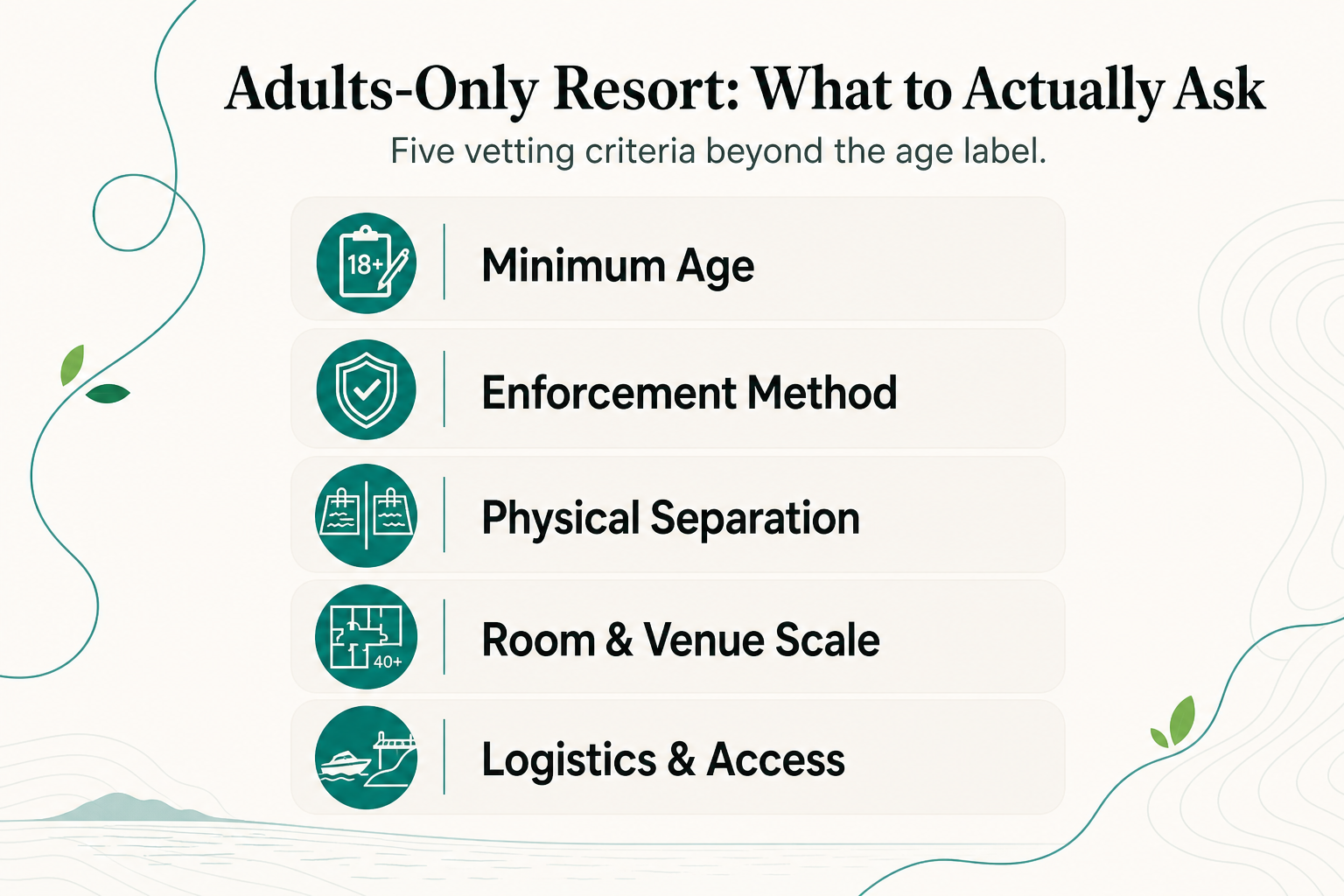
- "Adults-only" is a marketing term, not a certified standard. Minimum ages vary by property, typically 16 to 21.
- Ask about enforcement, not just policy. Many resorts advertise an age floor but don't check it at the door.
- Noise, pool access, and shared common spaces matter more than the age rule itself for a genuinely quiet stay.
- Remote island properties solve the "no kids" question differently: isolation and small room counts naturally limit who's around you.
- Confirm transfer logistics and connectivity before booking. A remote adults-oriented resort is only relaxing if getting there doesn't become its own ordeal.
What Does "Adults-Only" Actually Mean at a Resort?
It means the resort has chosen a minimum age for guests, nothing more. There's no third-party body auditing the claim or standardizing what counts as an adult. One property's 21-and-over policy and another's 16-and-over policy both get marketed under the same "adults-only" banner, and the experience they deliver can differ enormously.
This matters because couples often assume the label guarantees a certain atmosphere, quiet pools, no children's clubs, and romantic plating at dinner. None of that is implied by the age rule alone.
A resort can be technically adults-only and still feel like a convention hotel with a bar scene until 2am.
What to ask before booking:
- What is the exact minimum age, and is it enforced at check-in or only stated in the fine print?
- Does the policy apply resort-wide, or only to certain room categories or wings?
- Is the property adults-only year-round, or does it allow children during specific seasons?
Why Do Couples Choose Child-Free Travel in the First Place?
Couples choosing a child-free escape are usually optimizing for two things: uninterrupted time together and a predictable environment. An unscheduled trip where both partners can focus on each other without logistical caretaking often strengthens a relationship. That's a different goal from simply avoiding other people's children, and it changes what you should be screening for.
If the goal is reconnection rather than just quiet, the resort's layout matters as much as its age policy.
A property with 200 rooms and five restaurants will have more going on, more staff interactions, and more schedule friction than a small property where you see the same six other couples at breakfast.
Signals worth checking beyond the age rule:
- Total room count. Below roughly 30 rooms, an adults-only claim is easier to deliver in practice.
- Number of shared venues (pools, bars, restaurants). Fewer venues generally means fewer crowd-management problems.
- Whether excursions and activities are private/small-group or large shared tours.
How Do You Vet a "Family-Friendly" Resort That Also Claims Adults-Only Zones?
A resort that markets both family packages and an adults-only wing is running two businesses under one roof, and that split only works if the physical separation is real.
Ask whether the adults-only pool, beach section, or restaurant is physically distinct, or just a sign and a time window. A pool that's "adults-only after 4pm" is not the same product as a pool that's structurally separate from the family zone.
| Question | Why it matters |
|---|---|
| Is the adults-only area a separate building/beach or a shared space with time restrictions? | Determines whether "quiet" is guaranteed or just scheduled |
| Are breakfast and dinner served in a shared dining room? | Family noise at meals is the most common complaint in mixed-policy resorts |
| Does the resort disclose its enforcement method (ID check, booking system flag, staff discretion)? | Policies without enforcement are frequently ignored at busy periods |
This is the core tradeoff: mixed-policy resorts can offer more amenities overall, but they ask you to trust a schedule rather than a structural fact.
A fully adults-only, small-scale property removes that trust requirement by removing the other population entirely.
Does a Remote, Small-Scale Island Resort Solve This Differently?
Scale and remoteness solve the mixed-policy problem by making it structurally impossible to have a large children's program in the first place.
An island property with no scheduled children's activities, no kids' club, and a single shared dining area naturally skews toward couples and small groups rather than families running a packed activity schedule. We built Reconnect around that model: 8 room types across 20 rooms on Buka Buka Island in the Togean archipelago, an administratively defined part of Tojo Una-Una Regency in Central Sulawesi.
Remoteness does the filtering that an age policy would otherwise have to do by rule.
Getting to the island requires a car transfer from Luwuk Airport to Ampana (around 5 hours) followed by a 30-45 minute speedboat crossing. That self-selects for travelers planning a deliberate stay rather than a casual weekend, which is part of why the resort's guest mix skews toward couples, divers, and small groups rather than large family tours.
The flip side deserves honesty: we don't market ourselves as strictly adults-only, and several of our accommodations (Le Cabanon, Villa Athena) sleep up to four and are built for families or small groups.
Couples wanting a guaranteed zero-children environment should ask any property, including ours, directly about current bookings for their travel dates rather than assuming based on marketing copy.
What a remote setting does guarantee, regardless of age policy:
- Low total guest count by physical capacity, not by schedule
- No large-scale resort infrastructure (water parks, big conference facilities) that typically brings bigger family groups
- Quiet dive and snorkel sites reached by short boat rides rather than crowded day-tripper beaches
What Logistics Questions Matter as Much as the Age Policy?
A quiet adults-oriented stay falls apart quickly if the practical logistics aren't handled, regardless of who else is or isn't there.
Before booking any remote or island property, couples should confirm:
- Connectivity. Can you actually disconnect, or does spotty signal force anxious check-ins? Reconnect runs Starlink across the property specifically so guests can choose to log off rather than being forced to.
- Power reliability. Off-grid resorts vary enormously in how they handle electricity. Ours runs 93% on solar with battery backup, generator only as backup power, never primary.
- Water and meal inclusions. All-inclusive full-board (three meals, afternoon tea, unlimited coffee/tea/water) removes a layer of daily decision fatigue that matters more on a couples' escape than most people expect.
- Transfer coordination. Confirm whether the resort coordinates the full journey or leaves you to book multiple legs yourself. Ours handles the Luwuk Airport to Ampana car transfer and the speedboat crossing as one coordinated process.
Frequently Asked Questions
Is there a legal definition of "adults-only" for hotels?
No. It's a business policy each property sets independently, with no governing international standard.
What's a typical minimum age at adults-only resorts?
Most fall between 16 and 21, set entirely at the operator's discretion.
Do adults-only resorts check ID at check-in?
It varies by property. Ask directly whether the policy is enforced or simply stated in marketing materials.
Is a small, remote resort automatically quieter than a large adults-only hotel?
Not automatically, but a lower room count and fewer shared venues structurally limit guest volume regardless of stated policy.
What visa requirements apply to couples traveling to Indonesia's Togean Islands?
Standard Indonesian entry rules apply: a passport valid at least six months, plus Visa on Arrival or visa exemption depending on nationality.
About Reconnect
Reconnect is an island eco-resort in Indonesia's Togean Islands with an on-site SSI dive center, on-site desalinated water, and Starlink connectivity. All stays are all-inclusive full-board from EUR 60/night. Get in touch at reconnect.id.