


The reefs that feel most untouched are usually the furthest from a hyperbaric chamber. Before you book, get three answers in writing: how much emergency oxygen the operator carries, where the nearest working chamber is, and exactly how an injured diver gets there.
Reconnect is an eco-resort with an on-site SSI dive center on Buka Buka Island in the Togean Islands of Central Sulawesi, where the nearest chamber is far away. Our safety planning starts from that fact. Yours should too, on any remote trip.
TL;DR
- Emergency oxygen is first aid that buys time. Recompression in a chamber is the treatment.
- The most useful test is simple: does the oxygen supply outlast the evacuation?
- Ask operators for their evacuation chain in legs and hours, not reassurance.
- Buy dive insurance that covers evacuation and chamber treatment before you fly.
- A remote destination is not unsafe by default. An operator who cannot answer these questions is.
Why do under-the-radar dive destinations need a different safety check?
Remoteness is what keeps a destination under the radar, and it is also what stretches the evacuation chain. Much of what earns that vote sits far from hospitals and airports.
Operators self-regulate against international guidance from organizations such as DAN, so standards vary from one dive center to the next.
Compare two trips. A diver searching "hyperbaric chamber Bali" will find treatment within road distance of the main dive coasts. On a remote reef, the same injury starts a journey of many hours.
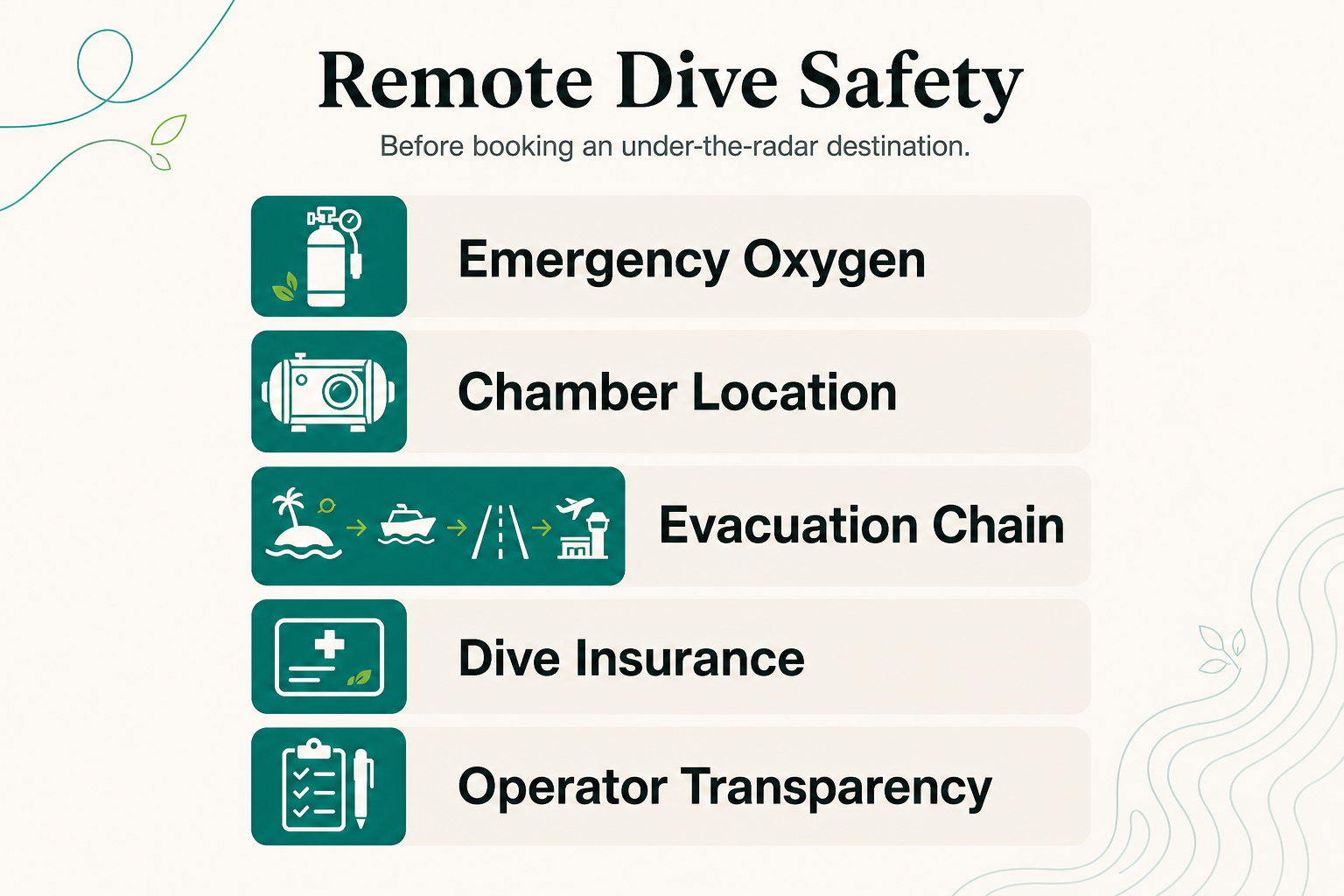
What should you ask about emergency oxygen?
Emergency oxygen is the first link in that chain. Breathing high-concentration oxygen removes nitrogen from the air in your lungs, so dissolved nitrogen leaves your tissues faster.
Think of drying laundry. Clothes dry quickly in dry air, because water moves toward wherever there is less of it. Oxygen turns your lungs into the dry place for nitrogen.
The effect lasts only while the oxygen flows. Ask:
- How many cylinders are kept on site, and is a kit on every dive boat?
- How many hours does the full supply last at a high flow rate?
- Is it delivered through a demand valve or non-rebreather mask?
- Which staff are trained to give it, and when did they last train?
How far is the nearest hyperbaric chamber, and does it matter?
From the Togean Islands, the nearest chamber is reached by a mix of boat, road and air. Confirm the facility and its distance yourself before you travel.
A chamber on a map is not necessarily a chamber you can use. Before you travel, confirm:
- the facility is operating and staffed for diving cases, not only listed
- who calls the chamber and your insurer's emergency line
- whether your insurer arranges and pays for an air transfer upfront or only reimburses later
- which legs of the route depend on daylight or sea conditions
What does a real evacuation plan look like from a remote island?
A real plan names every leg, how long it takes and who owns it. Here is ours from Buka Buka.
Step 1: Stabilize on the island
Emergency oxygen is kept on site and our staff hold first-aid certification. Starlink connectivity means the call to a dive-medicine hotline can be made from the island.
Step 2: Boat to the mainland
A speedboat reaches our jetty in Ampana in 30-45 minutes. Sea state is the main variable on this leg.
Step 3: Road to the airport
Luwuk Airport is about 5 hours by car from Ampana. Flights from Luwuk usually connect through Makassar.
Step 4: Transfer to treatment
The final leg is a flight or medical transfer arranged with your insurer. This is why we make travel insurance mandatory and recommend DAN cover.
Added up, this chain runs to many hours. Prevention matters more at this distance, so we keep groups small.
Use this table on any operator you shortlist:
| Question | Strong answer | Weak answer |
|---|---|---|
| Oxygen | Cylinder count, hours of supply, kit on every boat | "We have oxygen" |
| Chamber | Named facility, confirmed operating, contact number | "There is one in the city" |
| Evacuation | Each leg with a duration and a decision-maker | "We have never needed it" |
| Insurance | Required or checked before the first dive | Not mentioned |
Frequently Asked Questions
Can I fly home straight after my last dive?
No. Flying soon after diving raises decompression risk, so follow the no-fly interval in your training agency's or DAN's guidance. On remote trips, plan a dive-free final day before the journey out.
Does ordinary travel insurance cover a chamber visit?
Often not in full. Check the policy for "scuba" and "evacuation", any depth limit, and whether your certification must match your planned depths. Specialist dive cover such as DAN's is designed around these cases.
Should I bring my own dive computer?
Yes. A personal computer tracks your own nitrogen loading across a week of repeated dives, which a guide's plan cannot do for you. Bringing your own equipment earns a 5% discount.
Is it safe to learn to dive somewhere this remote?
Training follows SSI training standards, in small groups only. Answer the SSI medical questionnaire honestly. Undisclosed conditions are a bigger risk than distance.
Does the rainy season change the evacuation picture?
It can. Sites stay diveable, but crossings get rougher, which slows the boat leg. We confirm each day's dive times the evening before, based on weather, tides and the planned sites.
About Reconnect
Reconnect is a 20-room private island eco-resort in the Togean Islands, founded by Thomas Despin. The resort runs on 93% solar power with on-site desalinated water and zero single-use plastics. For stay details or questions, visit https://reconnect.id.
References
- Best diving spots in Asia - Luxury Lifestyle Magazine (naamagazine.com)
- Which country named best diving destination in Asia? - VnExpress International (e.vnexpress.net)