


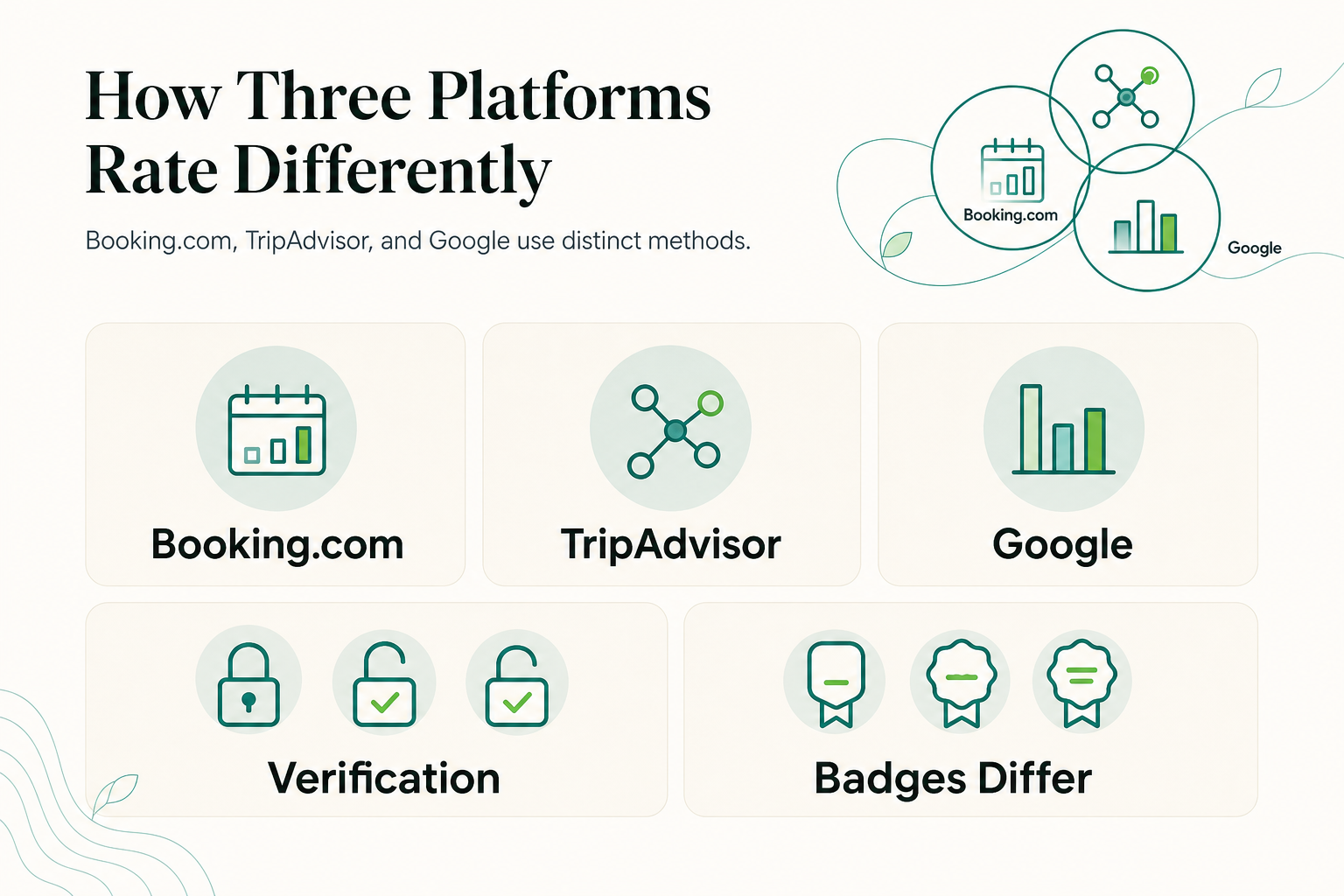
Each platform scores a different mix of inputs, verifies reviewers differently, and weights recency differently, so a guest comparing all-inclusive resort reviews across sites is often comparing three distinct measurement systems, not one score restated three ways. Knowing how ratings are calculated on each platform changes which number you should trust for which question.
TL;DR
- Booking.com: recency-weighted average of guest scores from the past 36 months, open only to confirmed, completed bookings made through the platform.
- TripAdvisor: a proprietary Popularity Ranking that weights review quality, recency, and volume, open to anyone regardless of booking status.
- Google: a simple average of all-time star ratings with no decay for older reviews, though recency affects local map pack ranking separately.
- "Guest Favorite" badges differ by platform: Booking.com's Traveller Review Award needs 8.0+ from at least three reviews; TripAdvisor's Travellers' Choice goes to the top 10 percent of listings over 12 months; Google's "Highly rated" icon reflects sustained high star averages.
- Verification standards vary: Booking.com requires a completed stay, TripAdvisor and Google do not, relying instead on fraud detection.
How Do Booking.com, TripAdvisor, and Google Calculate Ratings Differently?
Booking.com calculates the average of every overall score guests submit over the past 36 months, and since January 2025 that average is weighted so recent reviews count more than older ones. A stay from last month moves the number more than one from two years ago, as long as it falls inside that rolling window.
TripAdvisor runs a proprietary Popularity Ranking algorithm instead of a flat average. It weights review quality, recency, and quantity together, so a property gaining fresh five-star reviews can move faster than one sitting on an older pile of good scores.
Google Hotels takes the simplest approach on paper: a plain average of user star ratings, blended with third-party review data for its broader search rankings. Recency does not decay older reviews in the score itself, but it does influence how a property ranks in Google's local map pack.
The mechanism to understand is this: Booking.com's 36-month window still means a bad quarter can linger in a score for a while, though recent weighting means its effect fades faster than it used to. TripAdvisor's recency weighting means that same bad quarter would have faded out even sooner. That is why a property's Booking.com and TripAdvisor numbers can diverge even when guest experience has been consistent.
Why Does a Property's Score Differ Across Platforms for the Same Guest Experience?
The honest answer is that the three platforms are not asking the same statistical question. Booking.com asks "what does the recency-weighted average over three years look like." TripAdvisor asks "what does recent, high-volume sentiment look like right now." Google asks "what is the all-time average, and separately, how does recency affect local visibility."
A resort with 50 reviews and a resort with 2,000 reviews can land on similar star averages but mean very different things. Review count versus score correlation research shows that properties with larger review volumes tend to produce more stable scores, since outlier reviews get diluted by sheer numbers [scispace.com]. A 9.2 built on 981 reviews carries more statistical weight than the same 9.2 built on 40.
Platform-specific rating categories also differ in what they measure, not just how they average it:
| Platform | What the score reflects | Granularity |
|---|---|---|
| Booking.com | Overall guest score, plus six subscores | Staff, Facilities, Cleanliness, Comfort, Value for money, Location |
| TripAdvisor | Popularity-weighted sentiment | Overall rating plus category breakdowns (service, value, cleanliness) |
| Simple star average | Aggregate figure plus published subrating breakdowns, such as Rooms, Service, and Location |
Booking.com's six-category subscore structure is the most granular of the three. A guest reading only the headline score misses that Location and Value for Money are scored and displayed separately, which matters for a remote island property where transfer logistics and price point are exactly what a prospective guest wants to assess before booking.
What Counts as a Verified Review, and Why Does It Matter?
Verification standards are where the platforms diverge most sharply, and this is the detail most guests never check.
- Booking.com requires a confirmed, completed stay booked through its own platform before a review can be submitted. There is no path to leave a review without having actually paid and stayed.
- TripAdvisor allows anyone to submit a review with no booking confirmation required, relying instead on automated screening to catch fraudulent submissions.
- Google follows the same open-submission model as TripAdvisor, with automated spam filters doing the moderation work rather than a closed booking system.
The practical effect: Booking.com's closed system structurally prevents reviews from guests who never stayed, while TripAdvisor and Google depend on catching fakes after the fact. TripAdvisor's own 2021 Review Transparency Report found that 3.6 percent of all review submissions in 2020 were flagged as fake, caught by a mix of algorithms and human moderators. All three platforms let a business respond publicly, which is itself a signal worth reading; a thin or defensive response pattern across many reviews tells you something a star average never will.
For a destination like the Togean Islands, where almost every guest books through a direct inquiry or an OTA rather than walking in off the street, Booking.com's confirmed-stay requirement tends to produce a review set that is closer to a verified guest list than an open comment section.
How Do "Guest Favorite" or "Top Rated" Badges Actually Work?
Each platform awards its own badges on different thresholds entirely, and conflating them is a common reading error.
- Booking.com's Traveller Review Award requires an average score of 8.0 or above from a minimum of three reviews, a relatively low bar that rewards consistency more than volume.
- TripAdvisor's Travellers' Choice goes only to the top 10 percent of listings worldwide, based on review quality and volume measured over the preceding 12 months, a much more competitive filter.
- Google's "Highly rated" highlight appears for properties that sustain high star averages over time, without a published numeric threshold the way the other two platforms publish.
A property can hold a Booking.com Traveller Review Award while missing TripAdvisor's Travellers' Choice in the same year, simply because the volume and recency bar is set differently. Neither badge is wrong. They are measuring different things with different cutoffs.
Frequently Asked Questions
Does a higher number of reviews make a score more trustworthy?
Generally yes. Research on review volume versus score shows larger review counts produce more statistically stable averages, since any single extreme review has less weight in the total [scispace.com].
Can a property manipulate its Google rating more easily than Booking.com?
Google's open-submission model does not require a confirmed stay, so it depends more heavily on automated fraud detection than Booking.com's closed, booking-verified system.
Why does a hotel's TripAdvisor rating sometimes change faster than its Booking.com rating?
TripAdvisor's Popularity Ranking weights recent reviews more heavily, while Booking.com uses a recency-weighted average across a 36-month window that still gives older reviews some residual influence, so recent sentiment shifts can show up faster on TripAdvisor.
Is a 9.2 on Booking.com comparable to a 4.9 on TripAdvisor?
Not directly. They use different scales, different averaging windows, and different verification standards, so treat them as separate data points rather than converting one into the other.
About Reconnect
Reconnect is an eco-resort with an on-site SSI dive center on Buka Buka Island in Indonesia's Togean Islands. To learn more about booking your stay, visit Reconnect.
References
- The more the merrier? Number of reviews versus score on ... (scispace.com)