

Running dive courses in English, French, and Indonesian at the same small eco-resort with an on-site SSI dive center forces a level of standardization that single-language operations rarely have to confront. When an instructor has to deliver the identical skill sequence, the same safety briefing, and the same evaluation criteria to a German-speaking student on Monday and an Indonesian-speaking student on Wednesday, any gap in the course structure becomes obvious fast. That operational pressure, more than marketing language, is what actually reveals whether a dive center's training quality is real or just well-photographed.
At Reconnect, on Buka Buka Island in the Togean Islands, we run SSI instruction in English, French, and Indonesian, in small groups, serving as a gateway to Togean Islands National Park. This article is grounded in that daily operational reality, not theory.
TL;DR
- SSI requires dive centers to run a documented Quality Management System, keep training records for at least ten years, and staff only actively teaching, insured instructors affiliated with an official center.
- Teaching the same course in three languages exposes whether skill benchmarks are consistent or informally adjusted per instructor.
- Group size matters more than marketing copy: the industry standard caps recreational open water instruction at 8 students per instructor, dropping to 4 for children aged 10-11.
- SSI and PADI are comparable in curriculum rigor; the real differentiators are group size, instructor language fluency, and local site conditions.
- Visibility in the Togean Islands averages around 30 meters, giving students a genuine margin for error while learning buoyancy and navigation skills.
What Actually Defines Scuba Diving Certification Quality?
Certification quality is not a feeling, it is a set of measurable structural requirements. SSI requires affiliated dive centers to follow a global Quality Management System and to retain training records for a minimum of ten years.
Instructors must hold active teaching status, carry professional insurance, and be formally affiliated with an official SSI center. This structure enforces safety protocols consistently rather than leaving them to individual judgment.
Dive certification is a safety credential, unlike a hotel review. A poorly run course produces a diver who may not be competent to dive independently. The paperwork requirement is what lets a diver's certification be trusted anywhere in the world, years later, by an operator who has never met the original instructor.
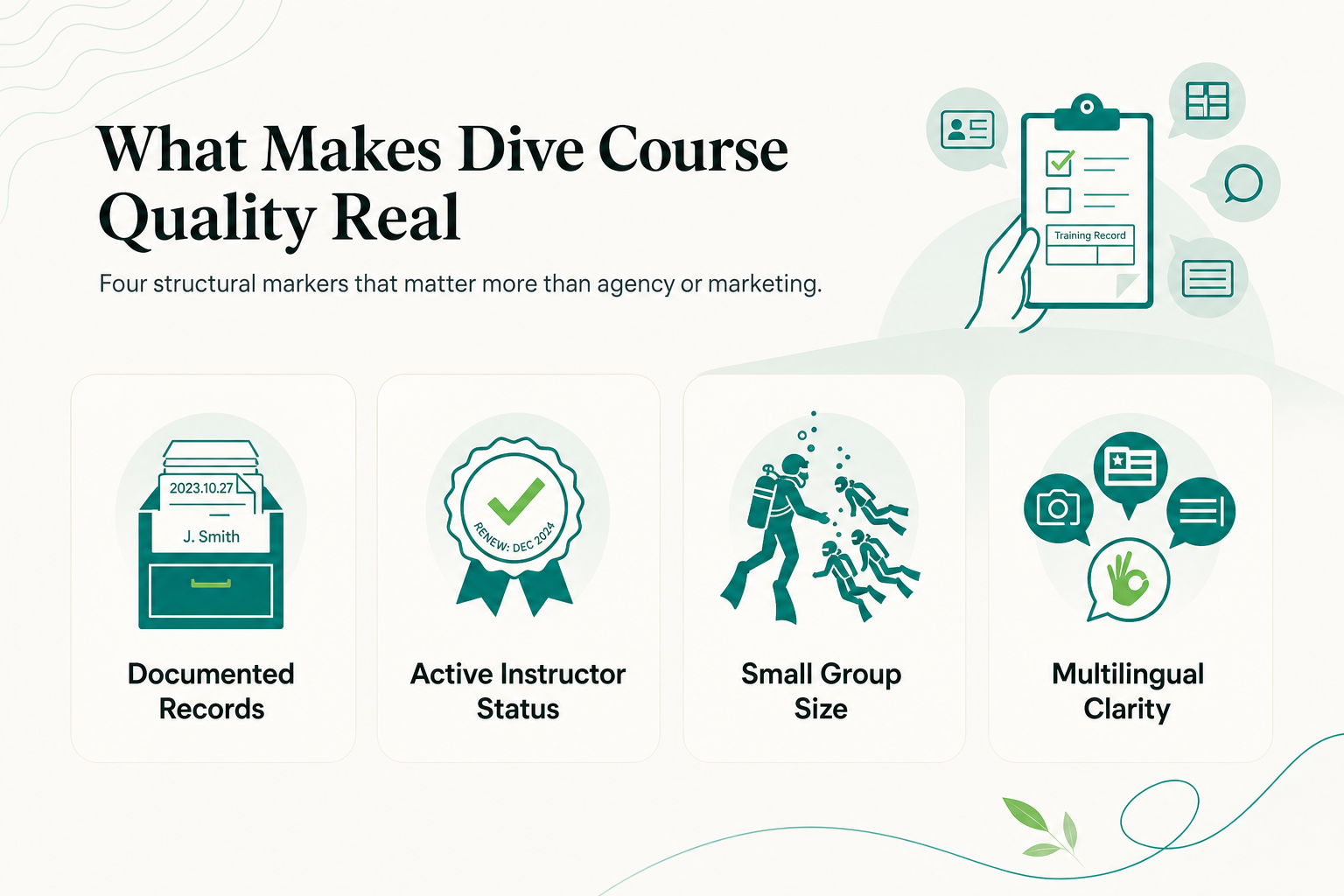
Three structural markers separate a rigorous course from a rushed one:
- Documented records. Ten years of retained training history means an operator can verify what a diver actually completed, not just what a card claims.
- Instructor status. Active teaching status and insurance are renewed, not permanent, so lapsed instructors are filtered out of the system.
- ISO and RSTC alignment. SSI maintains ISO certification and RSTC compliance, meaning its standards are benchmarked against the same international recreational training baseline used across the industry.
Why Does Teaching in Three Languages Change Course Delivery?
Teaching Discover Scuba Diving, Open Water, and Advanced Adventurer courses in English, French, and Indonesian at one small eco-resort with an on-site SSI dive center forces every skill benchmark to be written down rather than assumed. An instructor cannot rely on tone of voice or shared cultural shorthand to signal "this skill is not yet mastered, try again" if the student does not share a first language with them.
The briefing has to be explicit, the hand signals have to be standardized, and the evaluation criteria has to be identical regardless of which instructor is running the session.
Multilingual instruction becomes a genuine quality check rather than a convenience feature. If a course only works well in one language, parts of the curriculum are being delivered informally, filled in with cultural context or idiom that does not translate. A course built to work identically in three languages has stripped out that ambiguity.
Small group sizes make this standard achievable in practice. The industry standard for recreational open water instruction caps groups at 8 students per instructor, with increases to 10 or 12 allowed only when certified assistants are present. For children aged 10 to 11, that ratio drops to 4 students per instructor. Reconnect runs courses in small groups to stay well below that ceiling, which matters more in multilingual settings where an instructor is already doing extra cognitive work to communicate clearly.
SSI vs PADI Certification: Does the Agency Actually Matter?
For a recreational diver choosing where to certify, the SSI vs PADI certification question matters less than most marketing suggests. Both agencies are RSTC-compliant and both enforce the same 8:1 group size ceiling for adult instruction. The certification you end up with from either agency is recognized at dive operators worldwide.
Where the two systems genuinely differ is a naming detail that trips up a lot of first-time researchers: the five-dive course that follows Open Water. In SSI's system, this bookable course is called Advanced Adventurer. PADI calls its equivalent course Advanced Open Water.
SSI does have an "Advanced Open Water Diver" rating, but you cannot book it as a course. It is a recognition awarded automatically once a diver has logged four completed specialties and 24 dives. Confusing the two names leads people to search for a course that, under SSI, does not actually exist as a bookable product.
What should actually drive your choice between agencies:
- Which one the local dive center you plan to use is affiliated with, since switching agencies mid-progression is possible but adds friction.
- Whether the center offers instruction in your first language, since comprehension affects skill retention far more than the agency logo.
- The center's group size in practice, not just what the agency allows as a maximum.
What Should You Actually Ask Before Booking a Scuba Diving Course in Indonesia?
Scuba diving certification cost in Indonesia varies by location, agency, and course level. Courses are always sold separately from any accommodation package, never bundled into an all-inclusive room rate.
Before comparing prices, ask about the variables that actually determine whether the course will be worth it.
| Question | Why it matters |
|---|---|
| What language is instruction offered in? | Comprehension gaps during safety briefings are a real risk factor, not a minor inconvenience |
| What is the actual group size, not just the maximum allowed? | Smaller groups mean more individual skill correction time |
| Where do training dives happen? | Site conditions (current, depth, visibility) directly affect how much a student can practice |
| Is the instructor in active teaching status? | Confirms the course meets current agency safety requirements |
At Reconnect, a Discover Scuba Diving course introduces first-time divers to the water under direct instructor supervision. Open Water and Advanced Adventurer training dives take place at reef sites around Buka Buka Island, reached by a short boat ride from the resort. The Togean Islands offer an average visibility of around 30 meters, aided by the sheltered waters of the Gulf of Tomini. This gives students in a hover or navigation skill session room to see their own mistakes and correct them, rather than guessing at buoyancy in murky water.
Frequently Asked Questions
Is SSI or PADI better for a first-time diver in Indonesia?
Neither agency is inherently better. Both meet RSTC and ISO-aligned standards, so the deciding factor should be the specific dive center's instructor language fluency and group size, not the agency name.
How long does an SSI Open Water certification take?
Course duration depends on how the center structures classroom, confined water, and open water sessions, and on how many students are in your group; ask the center directly for their specific schedule.
Do I need previous swimming experience for a Discover Scuba Diving course?
Discover Scuba Diving is designed for first-time divers with basic water comfort; it is not a certification course, but an introductory guided dive under direct instructor supervision.
Does a multilingual dive center cost more?
Not necessarily. Cost is driven by course level, group size, and location, not the number of languages an instructor speaks.
About Reconnect
Reconnect is an island eco-resort in the Togean Islands with an on-site SSI dive center on Buka Buka Island. We offer Discover Scuba Diving, Open Water, Advanced Adventurer, and specialty courses in English, French, and Indonesian. For more information and bookings, visit reconnect.id.