
Group size is the single biggest variable in how much water time, feedback, and correction a student diver actually gets during certification, and it rarely shows up on a price list. An instructor running an Open Water course at a 4:1 ratio gives each student roughly twice the individual attention of one running at the SSI maximum of 8:1. That difference shows up in skill confidence, comfort underwater, and how a diver performs on their first unsupervised dive, not just in how the course feels at the time.
TL;DR
- SSI sets a maximum ratio of 8:1 for adult Open Water courses, and 4:1 for confined-water Try Scuba without certified assistants.
- Smaller groups mean more in-water correction time per student, which affects skill retention more than course length or price.
- Scuba certification cost varies by ratio, location, and course length. A lower price per student often means a fuller group.
- Reconnect runs small-group SSI instruction in English, French, and Indonesian, with training dives at reef sites around Buka Buka Island reached by short boat rides.
- When comparing SSI vs PADI or evaluating open water certification price, ask for the actual group size first. The certification standard is only half the picture.
What Does SSI Actually Require for Student-to-Instructor Ratios?
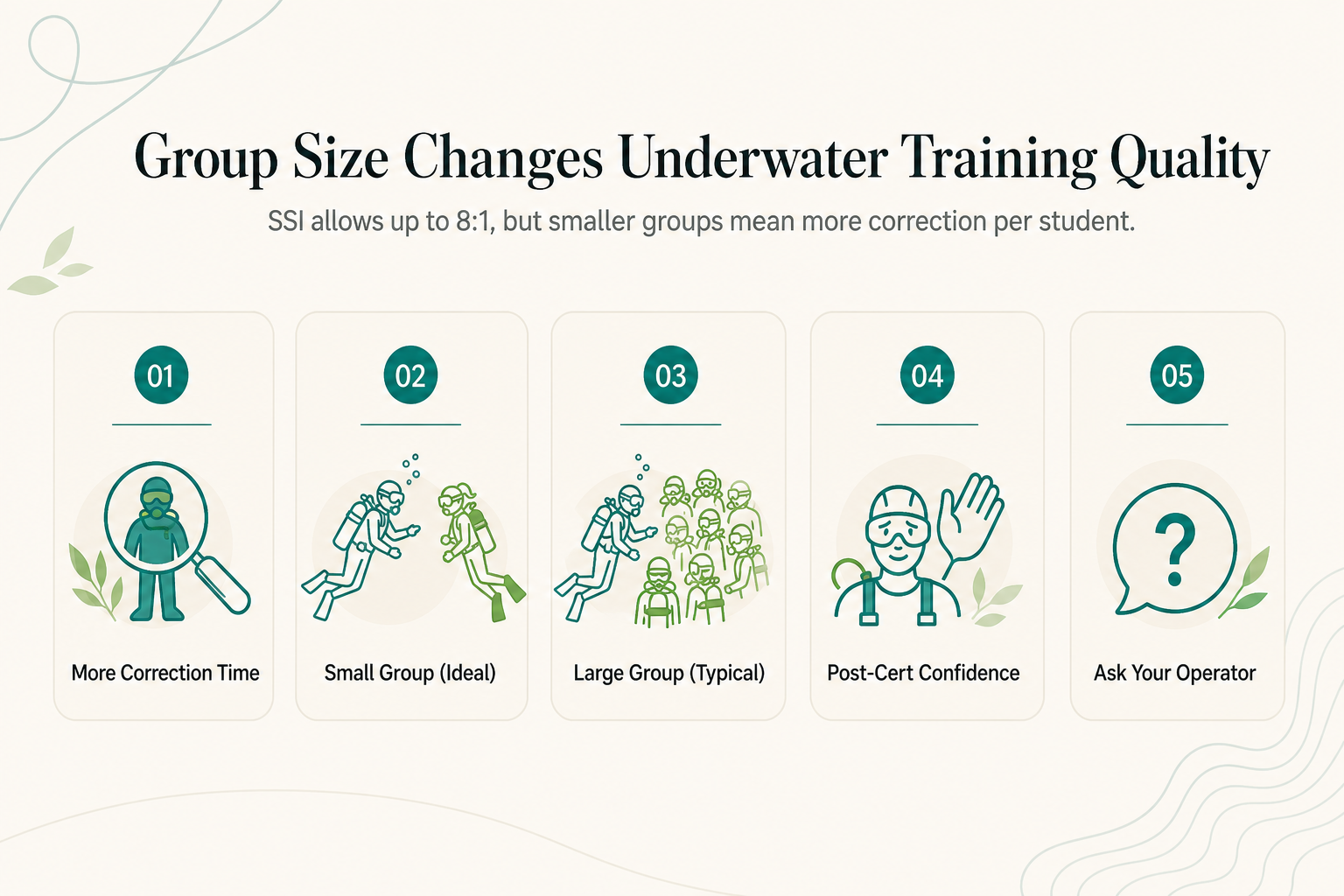
SSI's published standard caps adult Open Water courses and pool Try Scuba sessions at 8 students per instructor. Confined-water Try Scuba sessions without certified assistants are capped lower, at 4:1. These are ceilings, not targets. An operator is fully compliant running a course at 8:1, and equally compliant running it at 3:1 or 2:1.
This is the detail most comparison articles skip. "SSI-certified" tells you an operator meets the standard. It tells you nothing about where in that range they actually operate. Two operators can both advertise Open Water certification at the same price, with one running six students per instructor and the other running two, and both are telling the truth when they say "SSI standards followed."
Instructors are also required to hold an active Open Water Instructor rating and teach in a language the student is fluent in. SSI's MySSI platform delivers digital course materials and exams in over 40 languages. That handles the academic side. It does not touch the part of training that happens underwater, which is where group size actually bites.
Why Does Group Size Change Training Quality More Than Course Length Does?
A five-day Open Water course and a three-day one can produce very different divers if the group sizes differ. Here's the mechanism: every required skill (mask clearing, regulator recovery, controlled ascents, buoyancy control) needs direct instructor observation and correction, not just demonstration.
In a group of 8, an instructor has to split attention eight ways during every single skill circuit. A student who fumbles a skill gets noticed, but the instructor often cannot linger to re-drill it before moving to the next student. In a group of 2 or 3, the same instructor can watch a skill fail in real time, correct it on the spot, and have the student repeat it immediately while the mistake is still fresh.
This is the same reason a driving instructor with one student produces a more confident driver per hour than a driving school running four learners through a single lesson rotation. The total instruction time looks similar on paper. The corrective feedback loop per student is not.
The practical downstream effects:
- Skill retention: Students in smaller groups get more repetitions of corrective feedback, not just more total demonstrations.
- Comfort underwater: Nervous first-time divers get noticed and reassured faster in a 3:1 group than an 8:1 group.
- Pacing flexibility: A small group can slow down for one struggling student without the rest of the group drifting or losing air unsupervised.
- Post-certification confidence: Divers who got more individual correction during training tend to report feeling more prepared on their first dives after certification.
None of this is captured by the certification itself. Advanced Adventurer, the five-dive course that follows Open Water, has the same ratio ceiling and the same gap between what's compliant and what's actually good.
SSI vs PADI: What Actually Matters
The SSI versus PADI question gets asked constantly, but the agencies are closer on paper than the marketing suggests. Both run structured academic-plus-practical programs, both cap group ratios, and both require active instructor credentials. The meaningful difference in your actual training experience is almost never the agency logo. It's the ratio the specific operator chooses to run.
A useful reframe: stop asking "SSI or PADI" and start asking "what ratio does this specific operator run, at this specific location, for this specific course." That question applies whether you're comparing different certification bodies or comparing two SSI operators against each other.
| What to ask | Why it matters |
|---|---|
| Actual group size on your course dates | Determines real feedback time per student, not just compliance |
| Student-to-instructor ratio in confined water | Adult Open Water confined water sessions cap at 8:1; confined water Try Scuba sessions without certified assistants cap lower, at 4:1 |
| Language of instruction | Academic materials exist in 40+ languages, but live coaching needs a fluent instructor |
| Where training dives happen | Reef conditions and boat access affect how much of the dive is spent settling in versus skill practice |
What Does Scuba Certification Cost Actually Buy You?
Open water certification price varies by region, course length, and group size, and the three are connected. A lower per-student price often reflects a fuller group running through the same instructor hours. That's not automatically a bad deal, but it's the tradeoff worth naming before comparing numbers across operators.
Scuba diving Sulawesi, and the Togean Islands specifically, sits in the Coral Triangle. Visibility around Buka Buka Island averages about 30 meters. That reef quality is a constant across most operators in the region. Group size and instruction language are the variables that actually differ operator to operator, and they're the ones worth asking about directly before booking.
Reconnect's SSI course training dives happen at reef sites around Buka Buka Island, reached by a short boat ride, not on the house reef (which is reserved for complimentary snorkeling for all guests). Instruction runs in English, French, and Indonesian, in small groups. Courses are booked and paid for separately from the all-inclusive stay, which covers meals, house-reef snorkeling, kayaking, and paddleboarding.
Frequently Asked Questions
Does a smaller class guarantee a better diver at the end?
Not automatically, but it removes one major constraint. An instructor with fewer students can give more individual correction, which research on skill acquisition broadly supports, though instructor quality and student effort still matter.
Is SSI's Advanced Adventurer the same as PADI's Advanced Open Water?
They're comparable in structure (five dives, similar skill range), but the names aren't interchangeable. SSI's "Advanced Open Water Diver" is a separate recognition rating, awarded automatically once a diver logs four specialties and 24 dives, not a course you book.
Can confined water training happen in a group larger than 8?
No. Adult Open Water confined water sessions are capped at 8:1, and confined water Try Scuba sessions without certified assistants are capped tighter, at 4:1.
Does course price always reflect group size?
Not reliably. Price differences can reflect location, included equipment, or boat logistics as much as ratio. Ask your operator directly what group size you'll actually get on your dates.
Do all SSI operators teach in multiple languages?
MySSI's digital materials cover 40+ languages, but live in-water coaching depends on whether the instructor on-site is fluent in your language. Confirm this before booking, especially at remote locations.
About Reconnect
Reconnect is a private island eco-resort on Buka Buka Island in the Togean Islands, with an on-site SSI dive center offering small-group instruction in English, French, and Indonesian. Training dives use reef sites around Buka Buka Island reached by short boat rides. Stays are all-inclusive full-board from EUR 60/night; dive courses are booked separately. Learn more at reconnect.id.