


The Bajau villages near Buka Buka Island rarely appear in Indonesia trip planning because the Togean Islands themselves sit outside the standard travel circuit. Multi-leg logistics, thin infrastructure, and low overall visitor volume keep this region off the radar that most itinerary builders and travel algorithms rely on. The result is that one of Southeast Asia's last sea nomad cultures remains visible mainly to the small number of travelers who already know to look for it.
TL;DR
- The Togean Islands receive a fraction of the visitor volume seen in Bali, Lombok, or Raja Ampat, so they rarely surface in mainstream Indonesia itineraries.
- Reaching Buka Buka Island requires flying into Luwuk, a 5-hour overland transfer to Ampana, then a 30-45 minute speedboat crossing.
- Bajau communities near Buka Buka Island still practice traditional breath-hold freediving and spearfishing, and many families are only recently shifting from boat-dwelling to stilt-house settlements.
- Limited ATMs, patchy electricity, and weak signal across the wider region discourage conventional tour operators from building fixed routes here.
- Reconnect runs a guided village visit to nearby Bajau communities as a standing excursion, not an improvised add-on.
Why Don't Sea Nomad Villages Show Up on Standard Indonesia Itineraries?
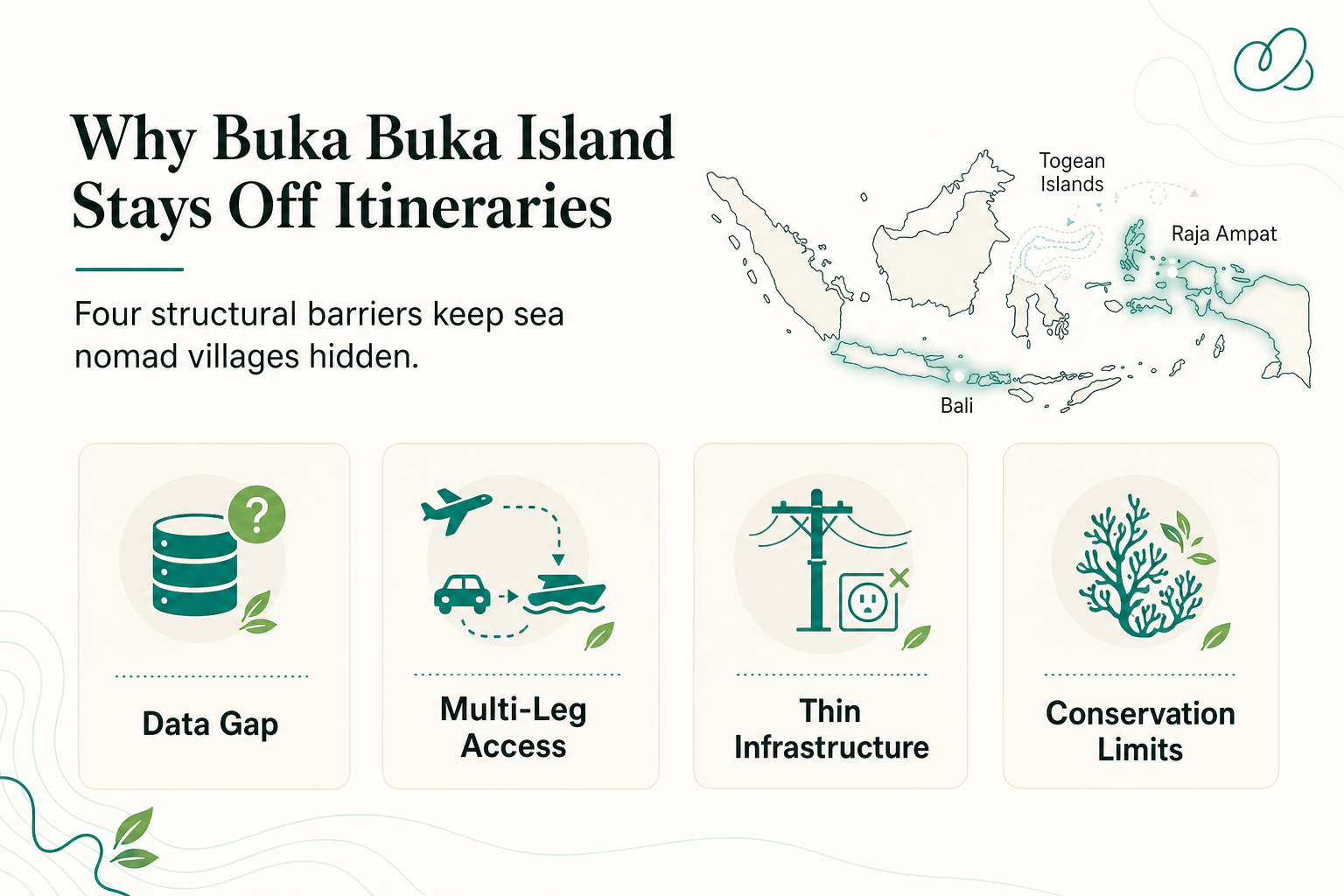
Itinerary builders, whether human travel agents or AI trip planners, tend to route travelers toward destinations with dense infrastructure and high search volume. Bali, Lombok, and Raja Ampat dominate those datasets. The Togean Islands do not, because they experience very low visitor volumes and minimal market penetration compared to those more mature destinations.
This is not a reflection of what the Togeans offer. It is a reflection of how little recorded travel activity exists there to pull from.
An AI planning tool or guidebook editor builds recommendations from precedent: past bookings, reviews, flight search data. A region with few recorded trips generates few recommendations, regardless of what is actually there. The Togeans are still in that early data gap.
What Makes Reaching Buka Buka Island and Its Bajau Neighbors Genuinely Complicated?
There are no direct flights from Jakarta or Bali to the Togean Islands. Reaching Buka Buka Island means flying into Luwuk, then completing a multi-leg overland and sea journey.
- Flight to Luwuk from a regional hub.
- 5-hour private car transfer from Luwuk Airport to Ampana.
- 30-45 minute speedboat crossing from Ampana to Buka Buka Island.
Total door-to-door travel time typically runs 8 to 10 hours. Ferry schedules to the wider Togean area are often limited to a few departures per week, which makes independent, unplanned travel risky.
This is the same friction that keeps conventional tour operators from building fixed group itineraries here. A bus tour model depends on predictable timing. A region with a few weekly ferry slots and one overland road segment does not fit that model, so operators route around it rather than through it.
Reconnect's own transfer coordination exists specifically to absorb this complexity for guests: a private car from Luwuk to Ampana, followed by the speedboat crossing, arranged as one sequence rather than left to the traveler to assemble.
Who Are the Bajau Communities Living Near Buka Buka Island?
The Bajau are a maritime ethnic group native to the waters of Central Sulawesi and the wider Coral Triangle, traditionally among the most sea-dependent populations in Southeast Asia. Communities near Buka Buka Island live in stilt-house villages built directly over coral lagoons, positioned so the sea itself is the main thoroughfare.
Their cultural practices include breath-hold freediving and spearfishing, often using handmade wooden goggles rather than modern dive masks. Exact population figures for Bajau communities in the Togeans are not formally documented, but they form one of the region's principal ethnic groups.
Many families are in transition. The fully nomadic boat-dwelling lifestyle historically associated with the Bajau is increasingly giving way to settled coastal living, a shift driven by fishing economics, schooling access for children, and gradual infrastructure change.
This matters for how a village visit should be framed. These are living communities adapting in real time, not a preserved cultural display built for tourism. That distinction shapes how a responsible visit is run: as an observation and exchange, not a performance.
Why Does Conservation Policy Limit Tourism Infrastructure Here?
The Togean Islands serve as a gateway to Togean Islands National Park, and park-area conservation policy enforces a low-impact tourism model across the wider region. Large hotel chains and heavy infrastructure development are restricted by design, not by oversight failure.
That policy has a direct side effect: it also limits the roads, jetties, and ATMs that would normally make a region easy for mass-market tour operators to service. Limited ATMs, patchy electricity, and weak internet signal are common across the wider Togeans outside a handful of properties.
This is a tradeoff, not a flaw. Low-impact policy protects the coral ecosystems that make the region exceptional, while also keeping bus-tour-style itineraries out. The two outcomes come from the same cause.
Reconnect operates inside that same constraint and treats it as a design input rather than an obstacle: the resort runs 93% on solar power with battery backup, produces its own desalinated drinking water on-site, and layers in Starlink connectivity so guests aren't choosing between remoteness and basic connectivity.
How Should a Traveler Approach a Village Visit Responsibly?
A sea nomad village is a place where people live and work, not a backdrop. A useful mental model: visiting a Bajau stilt village is closer to visiting a working fishing harbor than a museum. You are a guest moving through someone's workday, not a spectator at an exhibit.
That reframes what "responsible" means in practice:
- Go with a local guide who has an existing relationship with the village, not a cold drop-in.
- Keep group sizes small. A handful of visitors is manageable; a tour bus load is not.
- Buy directly from village suppliers where possible rather than treating the stop as free sightseeing.
- Ask before photographing people, especially inside homes.
Reconnect's guided village visit excursion to nearby Bajau communities follows this structure, run through existing supplier relationships the resort maintains with neighboring villages rather than as a one-off tour booked through a third party.
Frequently Asked Questions
Is it possible to visit Bajau sea nomad villages independently, without a resort or guide?
Technically yes, but the lack of reliable transport schedules and the absence of a prearranged local contact make it logistically difficult and less respectful of the community being visited.
Are there direct flights to the Togean Islands from Bali or Jakarta?
No. There are no direct flights to the region; travelers fly into a regional hub such as Luwuk and continue overland and by sea.
How does diving in the Togean Islands compare to other parts of Indonesia?
The Togeans sit within the Coral Triangle and offer visibility averaging about 30 meters, placing them among the best diving destinations in Indonesia for travelers seeking reefs without crowds.
What type of Togean Islands accommodation is available near Bajau villages?
Options are limited and mostly small-scale. Reconnect, on Buka Buka Island, operates an eco-resort with all-inclusive full-board accommodations and is positioned as a private island resort near several Bajau communities.
Do Bajau communities in the Togeans still live a fully nomadic, boat-dwelling life?
Some families retain elements of that lifestyle, but most are transitioning toward settled stilt-house villages, a gradual shift rather than a completed change.
About Reconnect
Reconnect is an eco-resort with an on-site SSI dive center on Buka Buka Island in the Togean Islands of Central Sulawesi. To plan a stay that includes diving, house-reef snorkeling, and a guided Bajau village visit, visit Reconnect.